
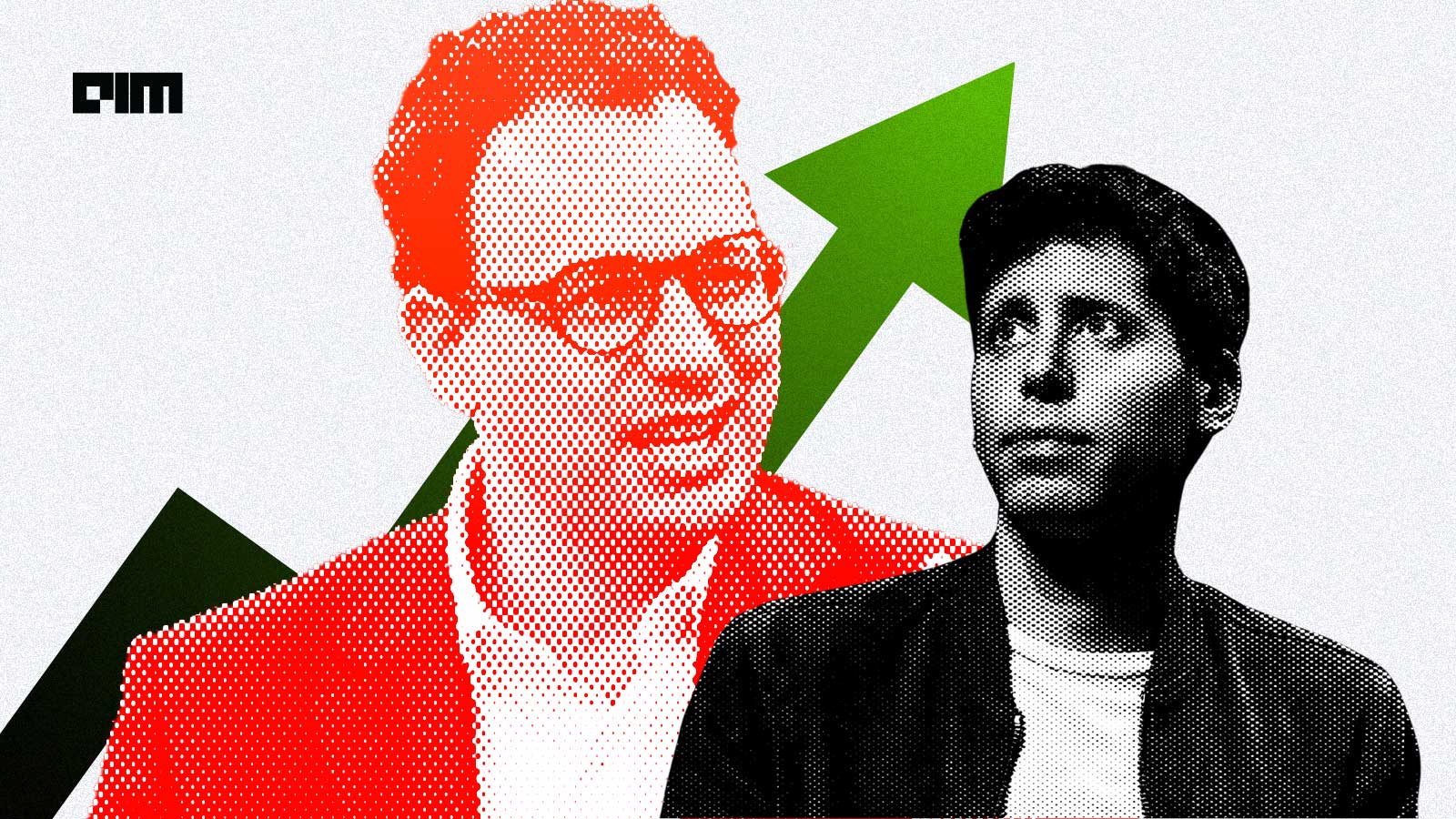
At the India AI Impact Summit, when OpenAI CEO Sam Altman and Anthropic chief Dario Amodei refused to join hands during a group photo to portray AI unity, it signalled more than their personal rivalry. That tension has very well spilt over to the companies’ standing among developers and in the wider ecosystem.
The numbers tell that story.
This April, Anthropic pulled ahead of OpenAI in annualised revenue, something few would have predicted even a year ago. The Claude tool developer has now crossed the $30 billion run rate mark, adding $21 billion in net new annualised revenue in just three months. This comes as Claude’s popularity has reached new heights, with data from intelligence platform Larridin showing that Claude’s usage surged 1,487% in under two months by mid-March this year.
Meanwhile, though OpenAI reportedly topped $25 billion in annualised revenue in February, a 17% increase from last year, it’s evidently not enough.
Anthropic Outpaces OpenAI
Anthropic got there by doing almost the opposite of what OpenAI did. It didn’t release any viral consumer app. No 900 million weekly users. Instead, there was a disciplined focus on enterprise API contracts, developer adoption, and Claude Code.
Anthropic’s strategy focuses on embedding AI into core software development workflows—debugging, testing, and autonomy—with 77% of business use involving automation usage patterns, according to the company’s analysis.
“Anthropic’s enterprise-first strategy is clearly translating into serious revenue, but ‘more durable’ is still too strong a conclusion,” observes Leslie Joseph, Principal Analyst, Forrester.
Similarly, Rahul Agarwalla, Partner at SenseAI, tells AIM that enterprise budgets and contracts are fundamentally more stable and durable than consumer preferences, which can turn on a dime. That is evident in ChatGPT’s app market share, which fell from 69% in January 2025 to around 45% this year, per mobile intelligence data provider Apptopia.
“Thus, at the outset, Anthropic’s enterprise-first revenue strategy looks more durable compared to OpenAI’s user-led growth,” he adds.
At the same time, Agarwalla points out that OpenAI’s strength lies in its expanding distribution layer. “OpenAI has built an impressive ecosystem, with integrations spanning devices from Apple to SearchGPT, making it significantly harder to ‘unplug,’” he says.
This breadth, he adds, effectively creates a moat, as deep and widespread embedding makes displacement increasingly difficult.
The Valuation Question
OpenAI’s $852 billion valuation is under increasing scrutiny from its own backers as the group switches focus to the enterprise market and tackles competition from Anthropic. The company raised $122 billion in March at that valuation, the largest private funding round in history, and yet the ink was barely dry before doubts began to surface.
One early backer of OpenAI said, “You have ChatGPT, a 1 billion-user business growing 50–100% a year, what are you doing talking about enterprise and code? It’s a deeply unfocused company,” the Financial Times reported.
Not so fast, OpenAI countered. In an internal memo that leaked within days, the company’s new Chief Revenue Officer, Denise Dresser, accused Anthropic of inflating its figures by roughly $8 billion through aggressive accounting of shared revenue from cloud partnerships.
Joseph cautions that current AI valuations need to be viewed carefully. “All valuation narratives in AI require caution at this moment,” he remarks.
He adds that these valuations assume sustained revenue growth despite high compute costs, uncertain long-term margins, and continued reliance on external infrastructure partners. “That does not mean the valuations are irrational,” he says. “They are pricing in category leadership, strategic optionality, and future market structure, not just present fundamentals.”
In his view, both companies remain “plausible as strategic bets,” though stretched relative to near-term fundamentals.
Agarwalla believes that the combined valuations of Anthropic and OpenAI exceeding $1 trillion suggest they are not being priced for a single market. “They are being priced for a future where these companies own multiple markets simultaneously,” he says.
Interestingly, Anthropic has recently drawn intense investor interest, with venture capital firms offering to invest at valuations as high as $800 billion, according to Business Insider. However, the company has so far declined or held off on these funding offers, choosing to remain selective despite the surge in demand.
IPO When?
OpenAI could debut on the public markets as soon as the fourth quarter of this year, CNBC reported. The clearest internal signal came from an all-hands meeting where Fidji Simo, OpenAI’s CEO of Applications, told staff the company is orienting aggressively towards high-productivity use cases.
The move also signals a pullback from science-focused and emerging programmes, which have led to leadership churn. Kevin Weil, who had been heading the company’s OpenAI for Science initiative, along with enterprise technology head Srinivas Narayanan and Bill Peebles, who worked on the now-defunct video generator Sora, have exited the company.
Meanwhile, Anthropic is reportedly targeting an IPO as early as October this year, with Goldman Sachs, JPMorgan, and Morgan Stanley in early discussions as potential lead underwriters. The company is targeting a raise exceeding $60 billion, which would rank among the largest IPOs of all time.
As Agarwalla points out, both companies are checking off all the prerequisites for public markets. They are maturing institutionally, with stronger board composition, governance, audit, and legal frameworks.
“The market in 2026 is no longer rewarding growth at all costs,” he adds, pointing to a shift in investor expectations. Instead, the focus is now on revenue quality, where “public investors are increasingly demanding unit economic clarity and predictability.”
Meanwhile, Joseph says the focus should be on governance, how consistently the companies disclose information, and the quality of their revenue mix.
Keeping the Cards Close
Amid all the valuation noise, the biggest development in the OpenAI–Anthropic rivalry isn’t money. Rather, both companies chose not to fully release their new models due to safety concerns.
Anthropic unveiled Claude Mythos, a general-purpose frontier model it kept in preview that can surpass most skilled humans at finding and exploiting software vulnerabilities.
Anthropic chose not to make the model generally available. Access is limited to a consortium of roughly 40 tech companies through a new initiative called Project Glasswing, focused on using Mythos to find and fix critical vulnerabilities before bad actors discover and exploit them.
The company also released Claude Opus 4.7, its latest publicly available model, with improvements in coding, reasoning, and long-running tasks.
OpenAI hit back soon. The company unveiled GPT-5.4-Cyber, a cyber-permissive variant of its flagship GPT-5.4, built for defensive cybersecurity and not public use.
It also introduced a new specialised model called GPT-Rosalind for life sciences and drug discovery.
What is clear as the AI ecosystem matures is that this is no longer a race between a dominant incumbent and a promising challenger. It is a competition between two genuinely large businesses with different models, different financial profiles, and different ideas about what winning looks like.

Your reaction