
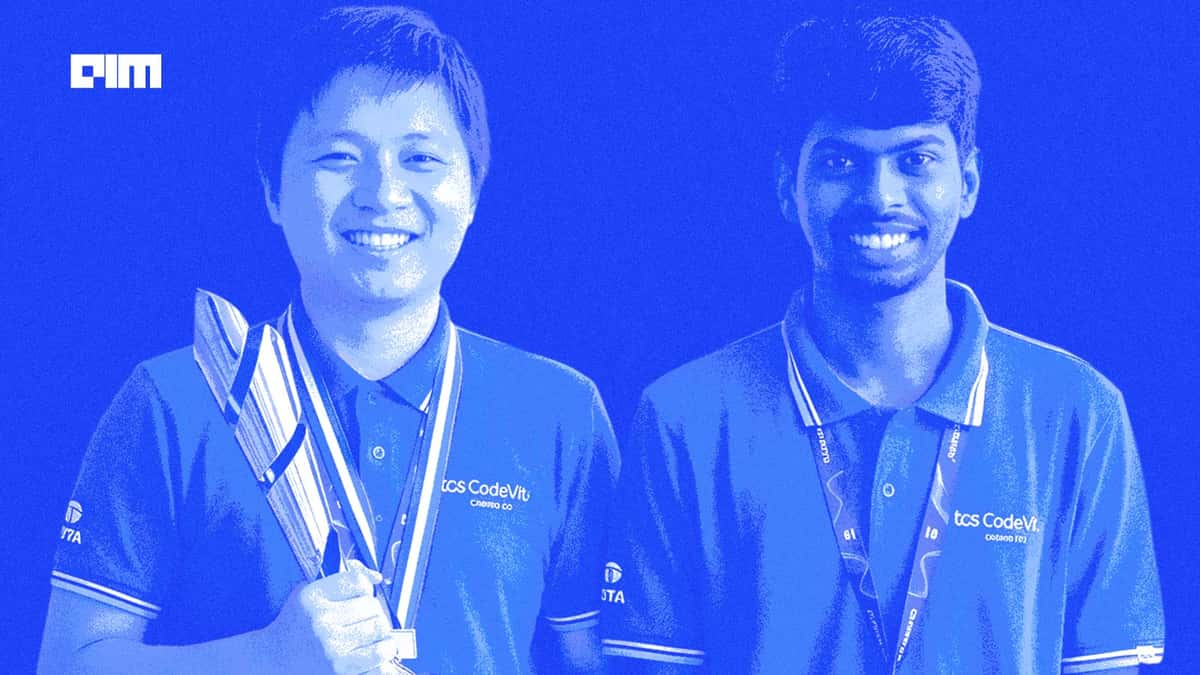

The Python code on Zhou Jingkai's screen was a mess. Poorly formatted, no indentation, broken line breaks. His task, in the final round of the world's largest programming contest, was to write a program that could automatically fix it in under six hours. He understood the logic. He ran out of time anyway.
Across the algorithmic battlefield, Balashiva S, a farmer's son from Karur, Tamil Nadu, competing in CodeVita for the first time, read a similar problem, remained calm, and solved it step by step.
Both coders left the 2026 edition of TCS CodeVita with titles. Jingkai, 21, from Hangzhou in China's Zhejiang province, took the coveted Best Coder award. Balashiva, 19, was named Best Emerging Coder, finishing 13th in the global finals. Their journeys to that stage could not have been more different.
China's Pipeline Starts Early
For Jingkai, competitive programming is almost a cultural institution. China's coding ecosystem is structured, high-pressure, and begins well before university.
"Some kids start super early, even in elementary school. The pressure to rank high and win is real," he says.
The National Olympiad in Informatics (NOI) identifies much of China's programming talent. Strong performance can impact university admissions, making algorithmic training more like an academic track than a hobby.
At Hangzhou Dianzi University, where Jingkai is in his final year, that culture persists through ACM-ICPC clubs, inter-school training camps, and shared online communities. His preparation for CodeVita was methodical, dedicating four to six hours on weekends to focusing not on quantity but on tackling weak points and solving problems he had previously failed at.
His contest strategy is equally deliberate. "I usually start with the easiest to build momentum and score quick points, then move to medium and hard. Saves time and reduces pressure," Jingkai says.
From the Farmlands of Karur
Balashiva's preparation looked nothing like that, yet it produced results that surprised even him.
In his second year of B.Tech in Information Technology at M Kumarasamy College of Engineering, Balashiva exemplifies India's self-driven, platform-taught, competitive tier-2 engineering students. He spends three to five hours daily on HackerRank, LeetCode, and CodeChef, prioritising problem-solving skills over ratings.
His Head of Department, K Ravikumar, sees a broader pattern in Balashiva's win. "Online coding platforms, peer communities and self-driven practice help students bridge gaps in curricula emphasising theory over problem-solving," he says. "Students from tier-2 and tier-3 institutions are increasingly improving their coding skills."
The CodeVita finals compress everything into a single six-hour session. Ten problems. Contestants move from readable code to optimised solutions under conditions designed to expose the limits of preparation.
For Balashiva, the pseudocode problem was the test he recalls most. "They provided pseudocode, and I had to convert it into a proper programme with correct indentation and structure,” he says. “I had to clearly understand the logic and carefully implement it without making syntax or formatting mistakes."
Jingkai faced the same problem with the Python auto-formatter and couldn't finish it in time. His honesty about that gap shows even top coders hit walls.
The AI Round
A new addition to this year's competition was an AI-assisted programming round, in which finalists could use frontier models such as ChatGPT, Claude Sonnet, and Gemini to help solve problems. The goal was to observe how programmers collaborate with AI in real time.
Both coders found AI useful in narrow ways and unreliable in others.
Balashiva used it to validate his logic and check edge cases. "Most of the time, AI suggestions were not fully accurate for competitive coding problems, so I carefully verified the logic and tested the solution myself," he says.
Jingkai took a more tactical approach. He typically used AI to convert his ideas into code snippets while writing the core logic himself. When the AI proposed incorrect solutions or overlooked constraints, he disregarded these and relied on his own reasoning.
Their conclusion, arrived at independently, was the same—the human judgment layer is irreplaceable. "The real skill is still knowing when to trust it and when to override," Jingkai says. "Accuracy stays on the human."
He adds that good prompts produce useful output quickly and compares it to learning how to ask the right questions, suggesting that this skill may be the key differentiator more than raw coding speed.
The 2026 edition attracted 146,922 participants, setting a new Guinness World Records title for the world's largest computer programming competition. It also sent 30 coders from eight countries and 22 from India to the global finals. Six Indian women reached the global top 30, marking the highest representation in the contest's 13-year history.
For Jingkai, the ambition after graduation is to work in autonomous systems. "I want to use my coding skills to build real self-driving systems."
For Balashiva, it is closer to home. "I want to work on AI-driven solutions that can solve real-world challenges in areas like agriculture, education, and healthcare."
- The Anthropic-Indian IT Partnership Is a Two-Way Bet
- Coforge Is Outgrowing Its Larger Rivals. Is AI the Reason?
- Are Boutique AI Firms India’s Next Big Thing?
- Indian IT’s New Workforces Come with a Margin Challenge
- ‘Owning of the IP Itself is Meaningless,’ Says Mphasis’ Ravi Vasantraj
- Infosys’s $5.2 Billion Deal Wins Fail to Lift FY27 Outlook