

For three decades, India’s Business Process Outsourcing (BPO) industry symbolised the country’s rise as the world’s back office. Millions of graduates staffed call centres in Bengaluru, Hyderabad, Pune, and Gurugram, handling customer queries for banks, airlines, telecom firms, and retailers worldwide. Today, however, that model faces an existential threat.
Artificial intelligence, particularly voice automation, is rapidly displacing human agents in customer interaction. Companies that once relied on India’s cost‑effective labour now deploy AI voice agents capable of handling up to 90% of queries at a fraction of the cost.
At the World Economic Forum in Davos, Dubai-based billionaire Hussain Sajwani warned that AI could disrupt 80% of India’s outsourcing sector.
Naushath Raja Mohammed, an AI analyst, explains that voice agents have fundamentally changed the landscape of customer service. “Customer interactions are now being used to train these models. This shifts the centre of gravity for BPOs from being people‑driven to one where AI works alongside humans. Even contracts increasingly focus on how AI agents will execute tasks and how they will be trained to improve quality.”
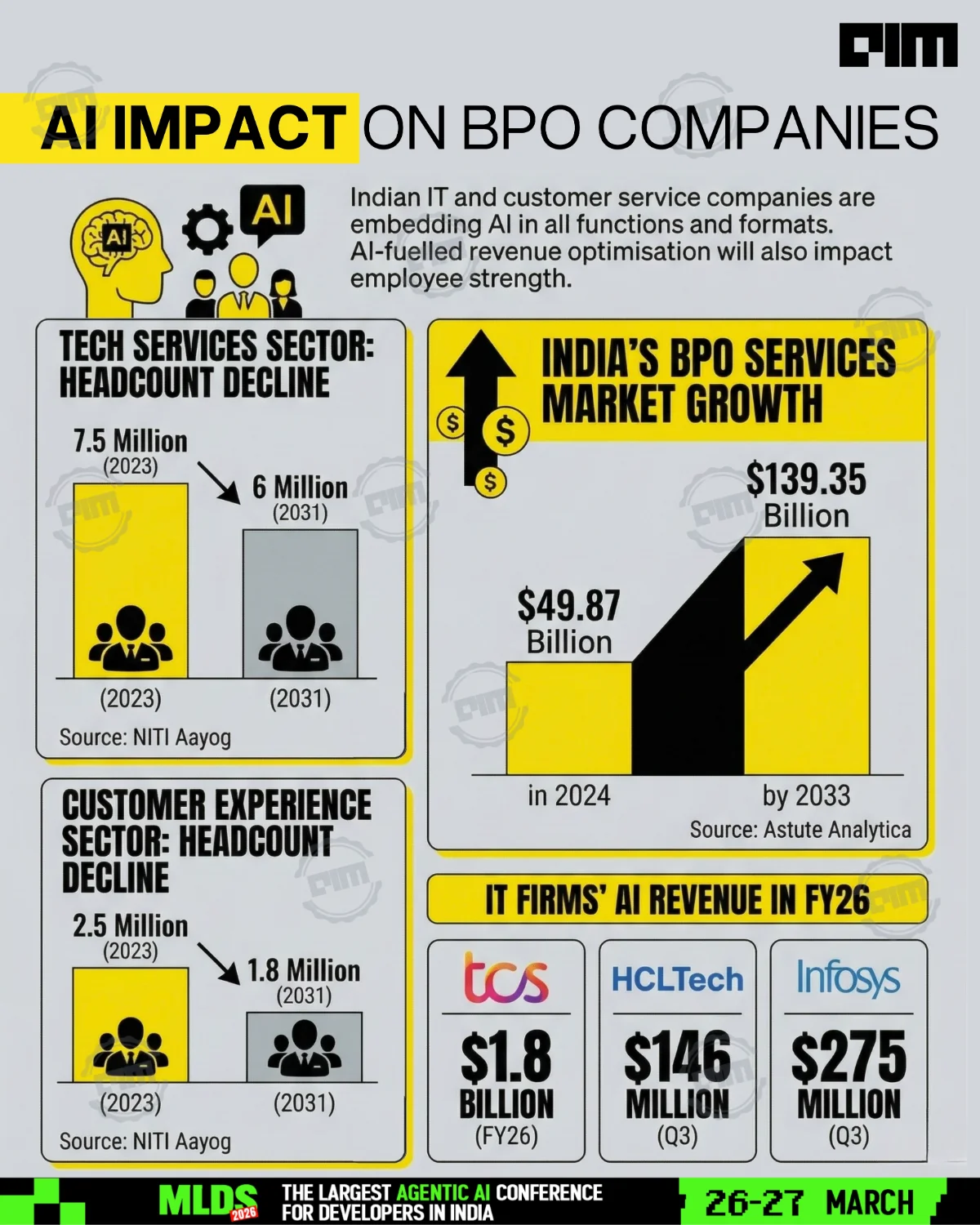
Although precise data on layoffs in the sector remains limited, a report from NITI Aayog projects that employment in the BPO sector could decline from around 2–2.5 million workers in 2023 to roughly 1.8 million in 2031. At the same time, the sector’s value is projected to reach $300 billion this year. In other words, revenue may continue to grow, but the benefits will not necessarily translate into proportional job creation or long-term employment stability.
Predictions of a Vanishing Model
Consulting firm McKinsey & Company projects that organisations will automate more than 60% of inbound inquiries by 2028. At the AI Impact Summit, venture capitalist Vinod Khosla declared that by 2030, IT services and BPO, as we know them, may effectively disappear. He argues that AI‑native services will replace traditional outsourcing, creating opportunities but also severe disruption for India’s economy.
Mohammed adds that voice agents have improved significantly over the past year, moving from proofs‑of‑concept to pilots and now into full-scale deployment. Their quality has advanced to the point where they can understand client requirements almost instantly. Although companies are increasing their investment in infrastructure to leverage large language models, the efficiency gains are substantial. The return on investment has not yet been fully quantified, but AI agents already outpace traditional offshore outsourcing models in speed and accuracy.
Skills Rendered Obsolete
The long-celebrated ‘Bangalore‑d’ trend, where Western companies outsourced work to India, takes a darker turn. The very skills that built India’s middle class—data entry and basic coding—are being rendered obsolete by agents that never sleep or ask for a raise, says AI consultant Frank Shines.
Zach Hansen, VP of AI Product Solutions at ReSource Pro, reframes the shift as a move from BPO to APO (Agentic Process Outsourcing). He explains that instead of throwing hundreds of people at document processing, companies are now managing high‑complexity knowledge graphs, orchestrating AI agents, validating outputs, and advising clients on how to restructure operations around this new reality.
Noting that every area of the BPO sector is being affected by automation, Mohammed adds, “In the past, AI adoption was limited by concerns about cost effectiveness and data security, but those issues have now been addressed. As a result, automation is spreading across functions, and displacement is expected to be significant in the coming years.”
Changing Client Demands
Traditionally, India’s BPO model relied on labour arbitrage, offering English‑speaking workers at lower wages than their Western counterparts. But AI voice agents now offer near‑human conversational quality, consistent tone, and real‑time responses.
Nirbhay Tiwari, Founder of Radiate E Services, observes that modern BPO call centres are no longer limited to traditional voice‑based support. Clients now demand faster resolution times, omnichannel experiences, and seamless customer journeys. AI and automation, he says, are redefining how BPO companies operate and maintain competitive advantage.
Market Growth Amid Disruption
Despite these changes, the overall market continues to grow. India’s BPO services market was valued at $49.87 billion in 2024 and is projected to surpass $139.35 billion by 2033, according to Astute Analytica. Despite this growth forecast, the sector faces disruption as AI adoption accelerates.
Mohammed points out that while India continues to have a skilled workforce and strong technical expertise, significant traction has also taken place in the Philippines. With the rise of voice agents, India is positioning itself to power and manage AI agents, ensuring that it remains a key player in the global outsourcing market.
Mixed Results Across Geographies
The adoption of generative voice AI has produced uneven results across markets. Oxyvin, a BPO technology provider, reports that while campaigns in the US using AI voice agents achieve strong results, deployments in India face challenges. Local customers often prefer human empathy in sensitive interactions, and regional language nuances remain difficult for AI systems to master.
Mohammed counters that AI voice systems are becoming increasingly mature due to the extensive datasets provided for training. “With the enormous amount of data available, these systems are now capable of handling India’s diverse linguistic and cultural nuances with far greater accuracy than before,” he says.
Employment Impact and Uneven Transition
Analysts warn that AI adoption could eliminate hundreds of thousands of jobs within five years. Hiring has already slowed, and attrition rates are rising as employees seek opportunities in e‑commerce delivery, gig work, or data labelling for AI systems.
A senior executive at a Bengaluru‑based outsourcing firm explains that the company used to hire 500 fresh graduates every quarter. Today, it brings in fewer than 50, with much of the workload handled by AI systems integrated into CRM platforms.
The transition is likely to be uneven. Smaller firms often lack the resources to retrain employees, while larger players such as Tata Consultancy Services and Infosys invest heavily in AI‑led services. TCS reports $1.8 billion in AI services revenue last quarter, underscoring its pivot towards becoming an AI‑led technology powerhouse.

Your reaction
Discussion
What's your take on this story?
No comments yet — be the first to share your view.