
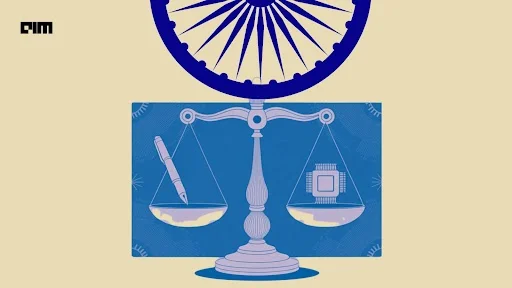
In 2024, when the news agency ANI filed a lawsuit against OpenAI, it touched a raw nerve for many digital news publishers. AI-powered search features and tools have been diverting traffic away from digital news media, with Pew Research finding that only 8% of users now click any link compared to 15% without AI summaries. The lawsuit was the first legal challenge in India, testing whether AI companies should be required to license content to train their LLMs.
The Department for Promotion of Industry and Internal Trade (DPIIT) subsequently released its working paper on generative AI and copyright in December last year. It marked India’s first serious attempt to address the core question of who owns and gets paid for the data that powers AI systems.
The working paper proposed a “One Nation, One License, One Payment” model where AI developers would receive a blanket licence to use all lawfully accessed, copyright content to train their models. Meanwhile, content creators will receive payment once the AI tools are commercialised.
Three months on, the process has entered a more politically delicate phase. Rather than moving quickly to regulation, the government is proceeding cautiously—prioritising consultation, sequencing, and institutional design.
Momentum picked up again at the India AI Impact Summit, where discussions highlighted the need to balance innovation with accountability, particularly around data governance and creator compensation. In a session, Robert Whitehead of the International News Media Association batted for paid training of AI models on journalistic content.
“There are billions of dollars being paid for professional content, but not to media companies. Companies in San Francisco that are buying [data] on the black market, that money needs to flow through to the media companies creating that content, and that will only happen when there’s a law that requires the tech platforms to participate in a fair digital marketplace,” he said.
With the summit over, policy focus has shifted back to the DPIIT paper. Experts AIM talked to say “the next step is not regulation but consolidation” among the stakeholders.
“The intention of the state is inclined toward some form of coordinated licensing system, even as the exact contours remain contested,” Gaurav Godhwani, Co-founder and Executive Director, CivicDataLab, a research lab working to strengthen the data-for-public-good ecosystem, notes.
A Staged Policy Rollout
The DPIIT process is unfolding in stages. The first working paper has already received initial feedback, which exposed deep fault lines between stakeholders.
Technology companies argued for flexible access regimes and warned against regulatory overreach that could stifle innovation. Publishers, media organisations, and creative industries, by contrast, pushed for stronger protections, transparency requirements, and compensation mechanisms, Godhwani says.
“The committee… consulted both the tech industry and the content industry separately and [received] sharply opposing views from each,” he remarks.
A second working paper—expected in the coming months—is likely to expand the scope significantly. It will address unresolved questions, including the copyrightability of AI-generated outputs, authorship, moral rights, and liability for infringing content.
This next document is critical. “Only once it is released will the government have the full picture on the table,” making it the “natural trigger for structured formal engagement” with industry, the data policy expert explains.
Towards Legal Change
While the government has avoided committing to a specific regulatory pathway, the contours of eventual legal reform are beginning to emerge.
Amendments to the Copyright Act, 1957, are widely seen as the most likely route. The current law does not explicitly address AI training, nor does it provide a framework for licensing large-scale data use in exchange for remuneration.
“The expected approach is a two-layer structure,” Godhwani notes. “Involving primary amendments introducing a mandatory blanket licensing provision and a statutory remuneration right supported by subordinate rules to operationalise the system.
This could include the creation of a new institutional mechanism—often referred to as a Copyright Royalties Collective for AI Training (CRCAT)—to aggregate rights, collect payments, and distribute royalties.
At the same time, a standalone AI law appears unlikely in the near term. India’s broader AI governance strategy has so far favoured sectoral and incremental regulation rather than sweeping horizontal legislation.
Even so, the eventual outcome is expected to be iterative rather than definitive, with elements potentially tested before being formalised into law, experts say.
Licensing Without a Market
Currently, there is an absence of voluntary licensing deals between AI companies and content owners in India—arrangements that are becoming increasingly common in the US and Europe.
In 2024, the Wall Street Journal owner News Corp signed a multi-year agreement with OpenAI, giving the ChatGPT maker access to new and archived news content. Recently, Meta also signed a multi-year AI content licensing deal with the publisher.
“Voluntary licensing at scale is not yet a reality in India,” Godhwani says, reflecting both the early stage of the domestic ecosystem and the lack of regulatory clarity.
This gap presents both a challenge and an opportunity. In the absence of a mature market, policymakers have greater latitude to shape the rules from first principles. At the same time, the lack of precedents makes it harder to design workable systems.
Interim solutions may emerge. “These could include metadata-level disclosures, purpose-driven data marketplaces, and data collaboratives that allow controlled access to datasets while building trust among stakeholders. API-based access models and sector-specific partnerships could also act as stepping stones towards a more formal licensing ecosystem,” he adds.
The Institutional Challenge
Designing the institutional architecture for a national licensing system may prove even more difficult than drafting the law itself.
A purely centralised model like the CRCAT—which would aggregate rights and distribute royalties—faces structural challenges in India’s federal system. Cultural and creative industries span both union and state jurisdictions, and the diversity of languages and formats complicates standardisation.
“Such a design does not sit easily with India’s federal structure,” cautions Arvind Singhal, MD of management consulting firm Technopak. “There is also a risk that a centralised registry could exclude informal and regional creators, particularly those operating outside formal digital systems.”
As a result, a hybrid approach is gaining traction. This would combine central coordination with decentralised participation, potentially through sector-specific or regional mechanisms that ensure broader inclusion.
The Problem of Fair Compensation
Even if a licensing framework is established, the question of how to distribute royalties fairly remains unresolved.
India’s creator economy is vast, fragmented, and unevenly digitised. Tracking the use of specific works in AI training data is technically challenging, while ensuring equitable compensation across different categories of creators adds another layer of complexity.
“Designing a fair royalty distribution model at scale presents an important opportunity but also requires participatory and inclusive consultations to balance competing interests,” Singhal adds.
Potential solutions include transparent attribution systems, right-sized disclosure requirements, and direct-to-creator payment infrastructure. Data marketplaces and collaboratives could also help smaller creators gain visibility and bargaining power.
Without such mechanisms, there is a risk that value could become concentrated among large intermediaries rather than flowing to individual creators.
A Balancing Act
India’s approach reflects a broader strategic calculation. The country is simultaneously seeking to position itself as a global AI hub and protect the interests of its vast creative economy. That tension—between innovation and regulation, access and control, scale and fairness—will shape the next phase of policymaking.
As Prith Banerjee, Senior Vice President at Synopsys, tells AIM, “You need guardrails, but not over-regulation. Excessive rules risk slowing innovation in a fast-moving field. Companies should be free to innovate within responsible guidelines.”
Yet Significant hurdles remain. Legally, there is still no clear consensus on whether using copyrighted material to train AI models constitutes infringement. Technically, the lack of robust auditing and data provenance systems makes it difficult to verify how training data is sourced and used.
Given these challenges, the implementation timeline is likely to be gradual. “A realistic timeline is likely to be gradual and extended rather than immediate, with operational frameworks potentially taking nine to twelve months to materialise after the full policy picture emerges,” Godhwani says.
Rather than rushing into law, the government is building a framework step by step—testing ideas, absorbing feedback, and navigating competing pressures. The result, if successful, could offer a distinct model for governing generative AI in emerging economies: one that is neither fully market-driven nor entirely state-controlled, but calibrated to India’s unique institutional and economic realities.

Your reaction
Discussion
What's your take on this story?
No comments yet — be the first to share your view.