
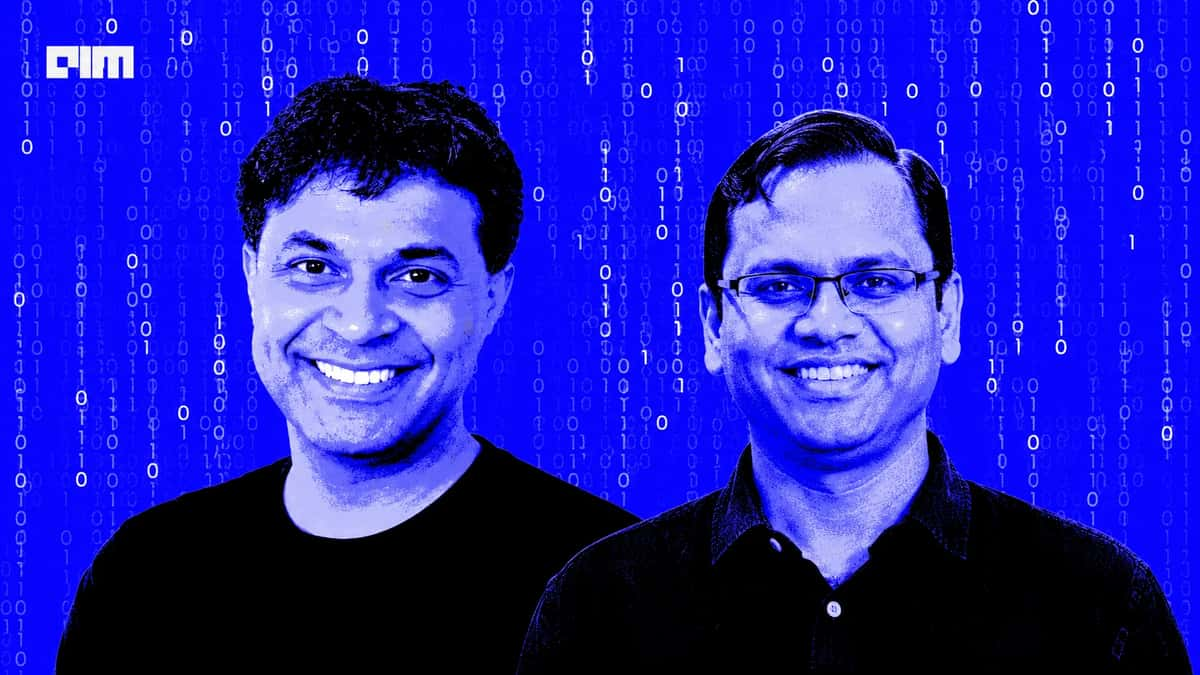

Following the first close of its $300 million Series B round led by HCLTech, Sarvam AI hosted its Epoch event in Bengaluru to unveil a new slate of models, products, and platforms.
Co-founder Pratyush Kumar said the company’s focus is no longer just on training models, but on building the infrastructure, products, and deployment stack required to translate frontier AI research into real-world systems for enterprises, governments, and developers.
Despite the availability of powerful open-weight models, Kumar said India cannot base its AI future on continued access to technologies developed elsewhere, open weights or not. He argued that Sarvam would continue investing in training frontier models because the process builds the engineering expertise, institutional know-how, and infrastructure needed to develop globally competitive AI from India.
Here are the key announcements from the event.
Improved Sarvam 105B Model
The AI startup has upgraded its recently launched Sarvam 105B model.
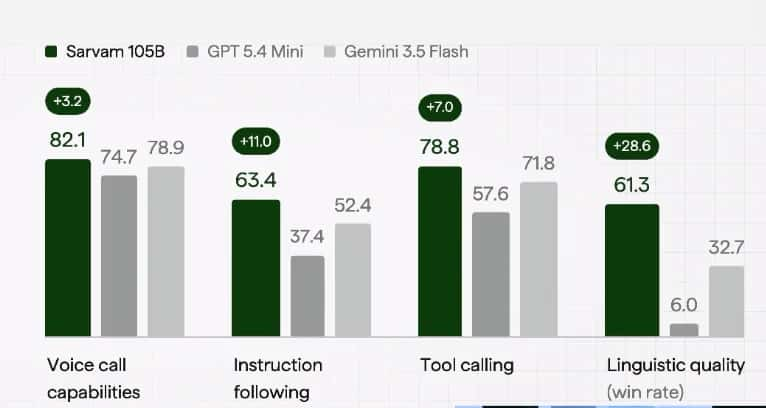
On a custom benchmark developed by Sarvam, the model now outperforms GPT 4.5 Mini and Gemini 3.5 Flash on voice call capabilities, instruction following, tool calling, and overall linguistic quality.
In terms of pricing, the model costs $0.80 per million tokens, cheaper than GPT 4.5 Mini ($4.50) and Gemini 3.5 Flash ($9). Sarvam also said that the model will be served at scale from India.
Sarvam also reaffirmed plans for its previously announced 1-trillion-parameter sovereign model, which it expects to complete within six months.
Sarvam Vision 2.0
Sarvam also unveiled Sarvam Vision 2.0, the latest version of its document intelligence model.
A key addition is native key-value extraction, which enables the model to directly extract structured information such as names, addresses, dates, and other fields from forms and documents into JSON.
The company said the feature was developed after working with enterprise customers, particularly in insurance, who require structured outputs rather than plain OCR (optical character recognition).
Sarvam also highlighted the model’s performance on two document intelligence benchmarks—olmOCR Bench, which evaluates OCR accuracy on dense, degraded, and real-world documents, and OmniDoc Bench, which measures structural understanding, including complex table extraction, reading order, and layout preservation.
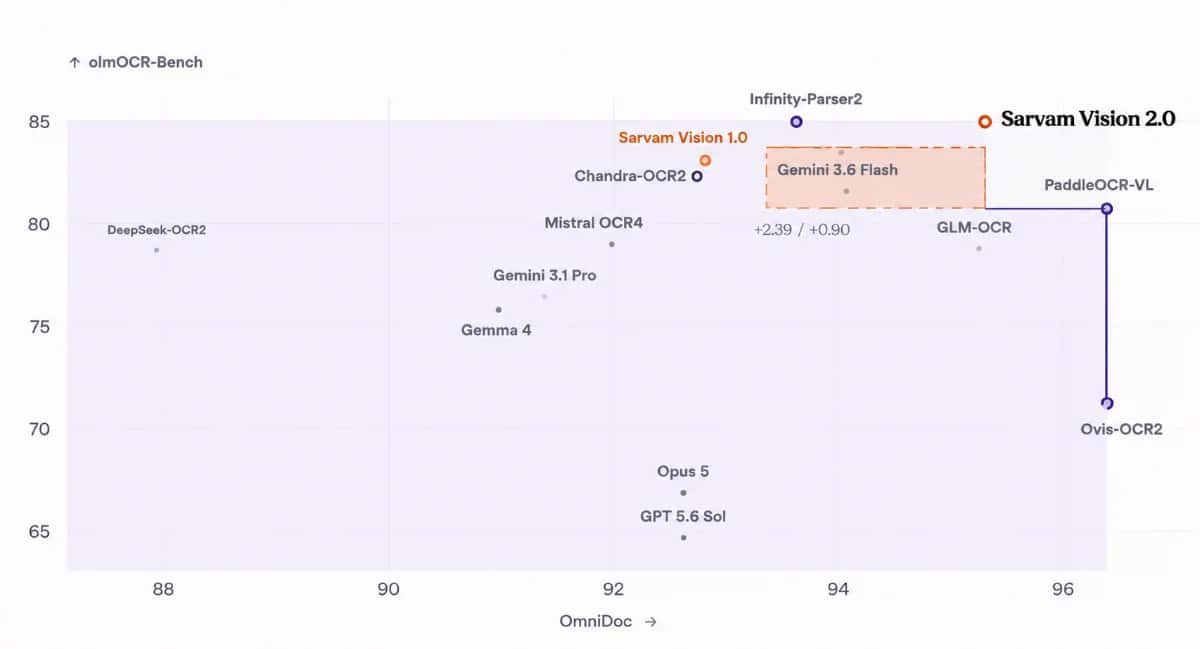
Most OCR and vision-language models are optimised for one benchmark at the cost of the other, excelling either at text recognition or document structure. Sarvam claims Vision 2.0 establishes a new Pareto frontier, improving performance across both benchmarks simultaneously without sacrificing accuracy on either axis.
The company also introduced Sarvam Vision Edge, an on-device version that can run locally on enterprise systems.
In a deployment example, Sarvam showcased its work with the Odisha government to digitise handwritten land records, using Vision 2.0 to extract structured information from complex archival documents. The model is available through Sarvam’s API and platform.
Saaras V4
Sarvam also unveiled Saaras V4, the latest version of its speech-to-text model, claiming state-of-the-art performance across 22 Indian languages, including low-resource languages with limited training data, while, for the first time, topping global English benchmarks. It claims the model outperforms competing models on Indic speech recognition.
On English, Sarvam said Saaras V4 achieved the best average performance across seven standard English ASR benchmarks (AMI, GogaSpeech, LibriSpeech and more), six of which are international benchmarks.
The company said Saaras V4 has been trained to better handle noisy audio and also introduced Saaras V4 Multi-Speaker, a new model designed to transcribe overlapping conversations.
Unlike conventional speech recognition pipelines that first separate speakers through diarisation (partitioning audio into speaker identities) before transcription, the new model combines speaker diarisation and transcription into a single architecture, enabling it to identify speakers and transcribe overlapping speech simultaneously.
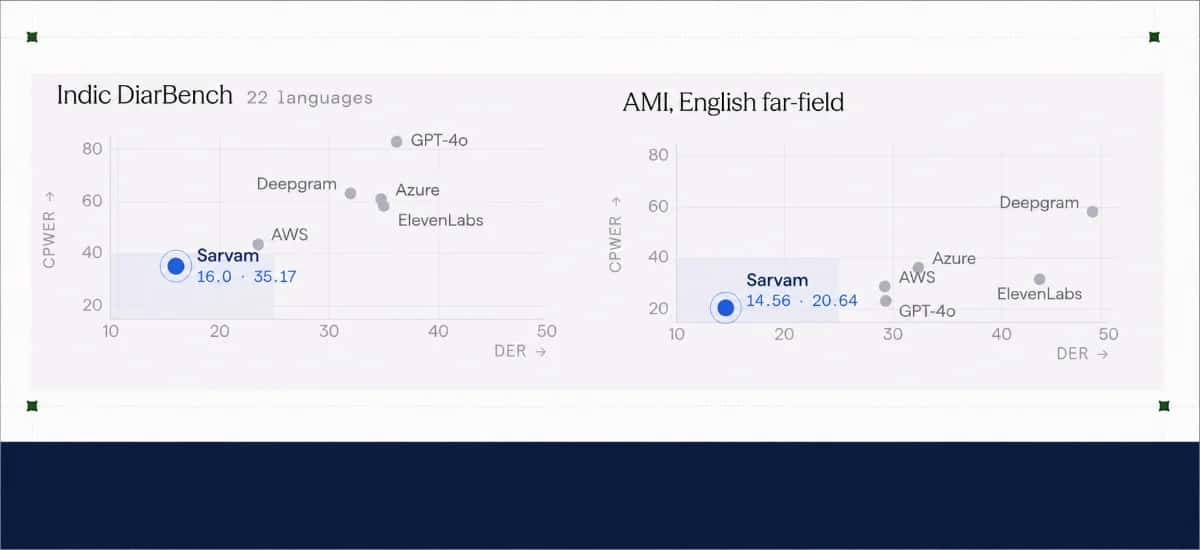
The company claims better multi-speaker recognition performance compared to ElevenLabs Scribe v2 and Deepgram Diarization v2 models.
Introducing Saaras V4 Multi-speaker
Our best-in-class speech recognition model that accurately captures overlapping conversations and multi-speaker interactions, while delivering state-of-the-art performance in English across accents. pic.twitter.com/fUXgnMQiet
— Sarvam (@SarvamAI) July 30, 2026
To support research, Sarvam open-sourced its Indic multi-speaker conversational benchmark, covering all 22 Indian languages with more than 108 hours of audio from 1,200 speakers.
According to the company, Saras V4 Multi-Speaker outperformed competing models on both DER (Diarization Error Rate) and cpWER (concatenated minimum-permutation word error rate)—two standard metrics used to evaluate speaker attribution and transcription quality.
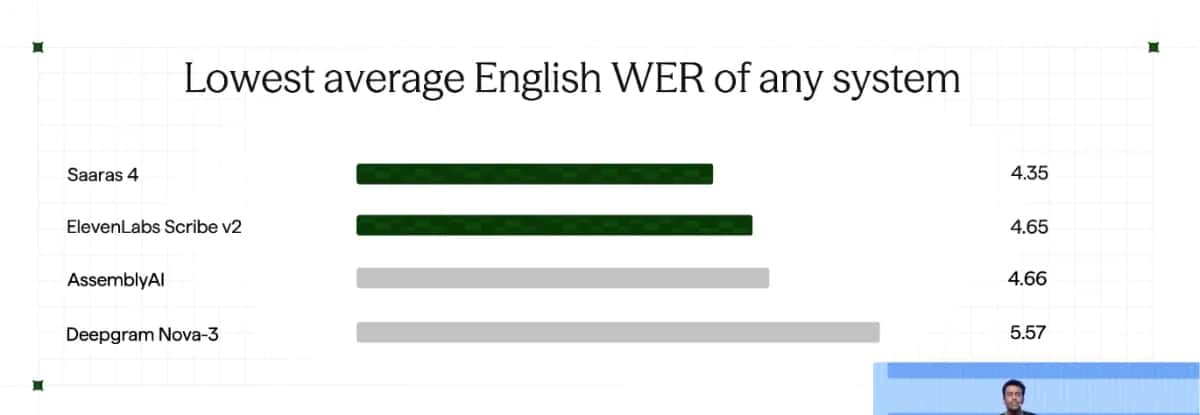
Both Saaras V4 and Saaras V4 Multi-Speaker are available through Sarvam's API and playground.
Bulbul v4
Sarvam also introduced Bulbul V4, the latest version of its text-to-speech model, with a focus on expressive speech generation and greater control over voice output. The company said the model allows developers to steer speech generation using emotion tags, emphasis controls, laughter, pauses, and other paralinguistic cues, enabling changes in tone and expression within a single utterance.
Bulbul V4 also expands its library of voices across multiple use cases, including voice agents, content creation, education, and sports commentary. According to the company, the model is designed to produce expressive speech across multiple Indian languages rather than just English.
Presenting Bulbul V4
Our Text-to-speech model with richer emotion, natural expression and greater vocal range.
Give it a listen: pic.twitter.com/6zQzbTpfAi
— Sarvam (@SarvamAI) July 30, 2026
Sarvam also announced a voice programme that allows brands, creators, and voice artists to build and deploy custom voices on its platform.
Model Training as a Service
Sarvam also introduced a Python SDK for training large language models on its cloud infrastructure. It abstracts distributed training, allowing developers to train models without managing GPU clusters, networking, or orchestration.
Initially supporting reinforcement learning with LoRA (RL-LoRA), the SDK uses an asynchronous training architecture that improves GPU utilisation while reducing the communication overhead typically associated with distributed training.
Sarvam Inference
Sarvam also introduced Sarvam Inference, a managed inference platform that hosts and serves open-weight AI models from infrastructure located in India. The platform will serve Sarvam’s own models, including Saaras, Bulbul, Vision, and its dubbing models alongside leading open-source foundation models.
It will also support GLM 5.2, Gemma 4 31B, and Sarvam 105B.
According to Sarvam, the platform has been optimised to deliver globally competitive pricing and low latency while running entirely from Indian infrastructure.
“The truth today is that if I want to use any of the top open-source models in the world, I need to do it when it's not hosted in India,” said Sarvam co-founder Vivek Raghavan. “If we want to control the intelligence, these models need to run on Indian infrastructure.”
The company claimed the service can improve inference performance by as much as 15x within a day for certain models. The platform will serve the 768-billion-parameter Mixture-of-Experts GLM 5.2 model at up to 80 tokens per second, while the Gemma 4 31B model is expected to deliver a time-to-first-token of under 0.6 seconds.
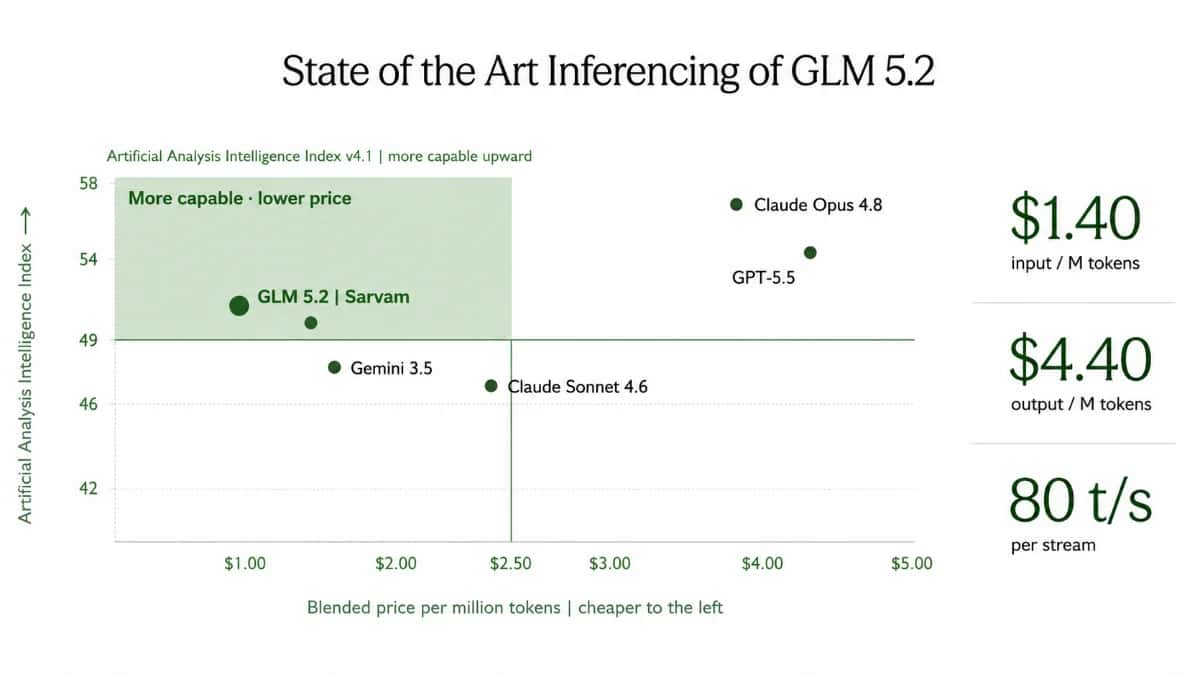
Sarvam also said its conversational models for instruction following, tool calling, and voice applications are priced at up to 9x lower than comparable offerings.
“We’re very serious about building a real token factory from India,” Raghavan said, calling domestic token serving “the first step to becoming sovereign.”
To support that vision, Sarvam said it now operates around 2,000 NVIDIA Blackwell GPUs, which it described as one of the country’s largest Blackwell deployments, and plans to scale that to 10,000 GPUs.
Indus Agents
Sarvam also expanded its Indus agentic AI platform with a suite of enterprise agents spanning voice, workplace productivity, document processing, and content creation. The features also include agent creation, automated testing, telephony integration, multi-agent workflows, and self-improving prompt optimisation..
The company said its voice agent platform, Samvaad, has already handled 325 million minutes of customer conversations over the past year.
Sarvam said its agents have achieved up to 3.5x higher conversion rates in production deployments while reducing costs to ₹3.5 per minute, compared with the industry average of ₹8–12 per minute.
For enterprise productivity, Sarvam launched Work Agents, a platform that combines long-running agents, enterprise connectors, secure sandboxes, and collaborative workflows. The company said the platform scored 79% on HarnessBench, outperforming the widely used Hermes framework, which scored 76%.
It also introduced a knowledge retrieval layer that, according to the company, delivers higher accuracy than conventional RAG-based approaches across multiple international benchmarks.
Sarvam also introduced Content Studio, which brings together voice cloning, text-to-speech, dubbing, and multilingual content generation. The platform includes over 50 voices and motion-picture-grade AI dubbing with lip-sync and emotion preservation.
In addition, it expanded its Document Agents platform with APIs for document digitisation, OCR, translation, and structured information extraction, powered by the newly announced Vision 2.0 models.
All of these capabilities are available through Sarvam’s Indus platform, where developers and enterprises can build, deploy, and manage AI agents.
New Coding Agents
Sarvam also unveiled the early beta of Sarvam Code, a coding agent built around a planner-worker-verifier architecture to improve long-horizon software engineering tasks. The company said the approach enables open models such as GLM 5.2 to achieve performance close to frontier proprietary systems at a fraction of the cost.
On TerminalBench, Sarvam Code solved nearly as many tasks as leading closed-model coding systems. It also scored 82% on Data Agent Bench, up from roughly 60% with a standard harness, and completed all 41 ExploitBench tasks, successfully chaining vulnerabilities into full-system compromises in 26 cases.
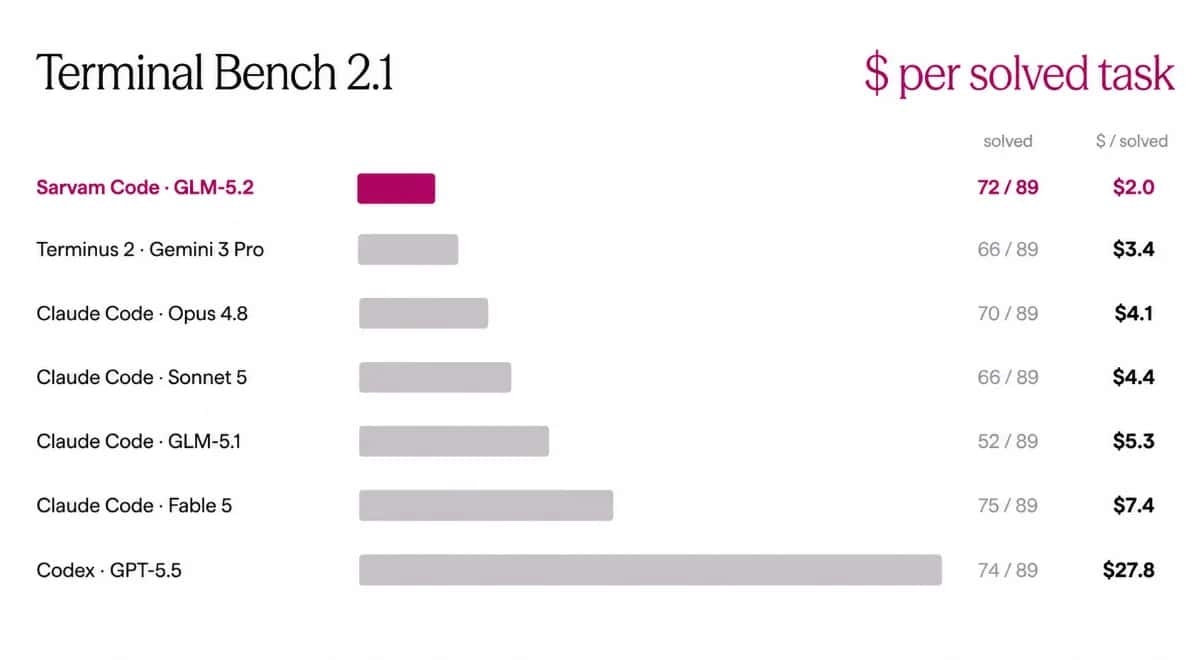
Beyond general-purpose coding, the platform includes dedicated modes for Android app development, data science and machine learning, and cybersecurity, supporting tasks ranging from app generation and model training to automated penetration testing and vulnerability remediation.
Sarvam for Defence
Sarvam also showcased Chanakya, its defence-focused AI vertical, alongside Anvaya, an on-premise intelligence platform designed for government and national security agencies. Built to run entirely within customer premises, Anvaya combines Sarvam’s models, inference stack, and agentic workflows without exposing sensitive data to the internet.
The platform is designed to ingest and analyse multimodal data, including documents, images, videos, and audio, to build knowledge graphs and generate analyst reports.
According to the company, Anvaya can perform multi-hop reasoning across large datasets while running on a 30-billion-parameter model deployed on a single GPU, enabling resource-constrained on-premise deployments for defence and intelligence use cases. Sarvam said the platform’s model-agnostic architecture also makes it applicable to sectors such as finance and healthcare.
Smart Glasses
Sarvam also demonstrated Kaze, a pair of AI-powered smart glasses that combine the company's speech, vision, and language models into a wearable form factor. The glasses support 22 Indian languages, can operate using both cloud and edge models, and are designed to continue functioning in low-connectivity environments while keeping inference costs low.
Targeted primarily at enterprises, the company said Kaze is being evaluated across sectors including healthcare, banking, tourism, and accessibility.
During the event, Sarvam also demonstrated how the glasses could assist visually impaired users by identifying buses, describing surroundings, translating text, and navigating everyday tasks using voice interaction
Kivi: Sarvam Takes on Wispr Flow, Granola
Sarvam also unveiled Kivi, a voice-first productivity assistant that aims to replace traditional keyboard-based interaction with speech.
Powered by the company’s automatic speech recognition models, Kivi supports dictation, multilingual translation, text editing, tone rewriting, custom vocabulary, and voice shortcuts, allowing users to control applications and edit text using natural language.
The company also previewed future capabilities, including voice-driven form filling, application control, message summarisation, reminders, and task automation, positioning Kivi as a broader human-computer interaction layer rather than a standalone dictation tool.
Kivi is available on macOS, with Windows and Android versions planned, while developer APIs will also be rolled out.
- The AI Slowdown Narrative Doesn’t Reflect Enterprise Reality
- India’s Enterprises are Scaling AI. Is the Infrastructure Ready?
- Industry Wants Faster Approvals and Cheaper Power in India’s Data Centre Policy
- Inside Jio Platforms: Its Tech Bets, Loss-Making Subsidiaries and Hidden Risks
- India’s GCCs to Add 1.4 Million Jobs, Drive 170 Million Sq. Ft. Office Demand by 2031
- AI Can Be Cyborg or Centaur. But Can Enterprises Monetise It?