
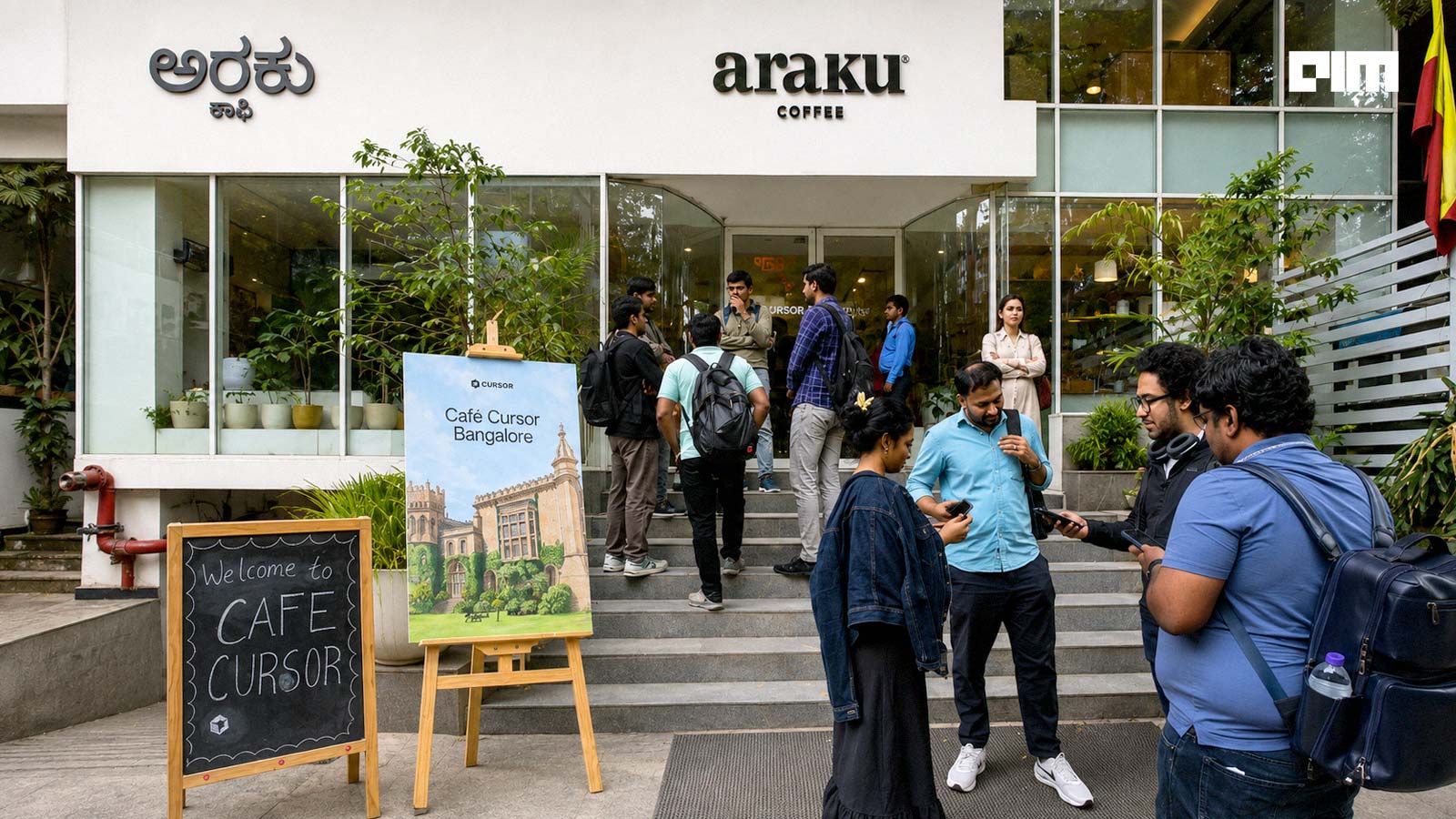
On a weekday in Bengaluru’s Indiranagar, where coffee shops double up as workspaces and laptops are as common as cappuccino cups, about 250 developers gathered at ARAKU Coffee for an event that felt less like a conventional tech conference and more like a conversation among builders.
The event, called Cafe Cursor, brought together developers experimenting with AI agents, founders building products and engineers using Cursor in their daily workflows. Staying true to the theme, the cafe even served its menu in code.
The gathering follows Cursor’s launch of its India-only Start plan at ₹649 a month. The company’s Indian user base has tripled over the past year to more than 3 million developers, making India its third-largest market globally. It also says Indian developers generate more agent requests per developer than users in any other market.
For a company acquired by Elon Musk’s SpaceX (now SpaceXAI) for $60 billion, India is becoming more than another revenue market. It is a place to build a developer community around AI agents.
New Office Coming Soon
Cursor plans to open its first office in India as the company expands its presence in one of its fastest-growing markets, a source had told AIM.
Simon Green, Cursor’s Head of Asia-Pacific and Japan, told Moneycontrol that the company will establish a physical presence in India before the end of the year. “Our first employees are just starting. Before the end of the calendar year, you will see us in physical locations,” Green said.
Cursor has already started building its India team, with recent hires across customer success, government affairs, technical support, and go-to-market functions. The physical office will give Cursor a base to grow its sales and enterprise operations in the country.
These employees are currently working remotely from Bengaluru, Delhi, Mumbai, Hyderabad, and Chennai. The company has also been recruiting for roles related to AI deployment, partnerships, and field engineering.
“Over the course of the next five months, you will see us make some fairly significant go-to-market efforts in India,” Green said.
A Bengaluru-Style Cursor Meet
The setting was distinctly Bengaluru.
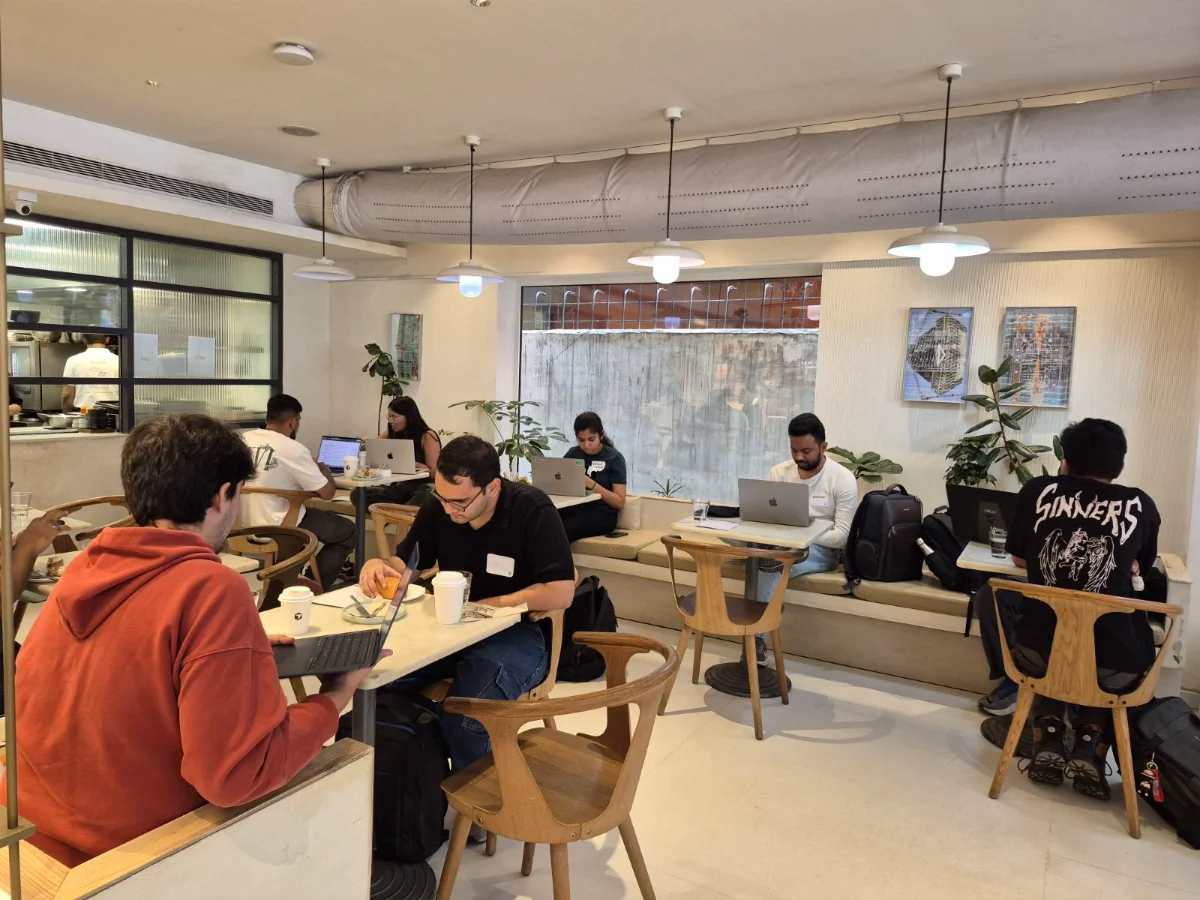
At ARAKU cafe, the usual Indiranagar mix of startup founders, engineers, and developers had come specifically to talk about Cursor. Developers sat together, exchanged workflows, and discussed how they were actually using AI agents to build software.
The event was part of Cursor’s broader push to build a local developer community. The company held its India roadshow across Mumbai, Delhi, Hyderabad, and Bengaluru, while its community programme now spans hundreds of events across cities globally.
Mohammed Sanjeed, Cursor’s Regional Lead for South Asia, an AI engineer and consultant, has been building with Cursor since 2023 and is helping the company establish its ambassador community in India. “There is a lot of demand in India,” he tells AIM.
India is Using Cursor differently
Sanjeed says Indian users are sending more agent requests per developer than in any other region. That makes India one of Cursor’s strongest markets for agent-heavy usage.
That usage is not limited to established software engineers.
Sanjeed recalls meeting a college student who was building websites and software for small- and medium-sized businesses, and had already made around ₹2 lakh. There were also solo founders building entire products with Cursor, engineers at funded Series A and Series B startups, and teams at larger enterprises.
“We have people from all ranges,” Sanjeed says.
Cursor is also expanding its enterprise presence in India. In January, it partnered with Infosys to establish a Centre of Excellence for software engineering agents. The partnership gives more than 100,000 Infosys engineers access to Cursor’s agentic coding capabilities and integrates the platform with Infosys’ Topaz Fabric.
Bet on India
On July 28, Cursor launched Cursor Start in India for ₹649 per month. The move came after repeated requests from Indian users for local pricing and UPI payments.
Cursor Start sits between the company’s Free and Pro subscriptions. It includes Grok 4.5, Composer, higher agent request limits, always-on cloud agents, iOS support, and integrations with plugins, MCP servers, hooks, and skills.
Sanjeed says Cursor’s cloud agents can continue working while developers are away from their machines. Through the iOS app, users can launch and control agents remotely. He explains its agents can build, test, and open pull requests while the developer continues working elsewhere.
Sanjeed believes this will become a bigger part of how developers work. “If you have the Cursor iOS app, you can just continue texting, chatting from there, and the agent will continue to complete the work,” he says.
Sanjeed says that agents can even interact with an application, click through interfaces, type, and complete tasks for the developer to review.
Deepak Kumar, a Bengaluru-based founder building the AI tools marketplace ToolJunction, observes that Cursor has become part of the day-to-day development process and the automation behind his platform.
ToolJunction lets users list websites and products they are building in the AI and agent space, helping them gain visibility through listings, blogs, newsletters, and categories. Deepak uses Cursor to automate much of the work involved in creating and managing those listings.
“I mainly use Cursor for the day-to-day complete development of what I have been doing on the platform, from development to automating workflows,” he said.
When a new application is submitted to ToolJunction, Cursor handles profile enrichment and prepares the listing before sending it through the platform’s review process. Once a reviewer approves it, the listing moves to the approved stage.
“The listing is completely automated with Cursor,” Deepak says. “When a new application comes for listing, all the profile enrichment and everything is done with Cursor, and then it goes into draft or review status.”
For Vedanth P, Founder and CEO of Aarogya ID, Cursor has become part of the development workflow at the health insurance startup, which works with insurers, governments, and hospitals to automate claims processing. The process still keeps humans in the loop, with humans and AI each handling parts of the workflow.
“Our goal is to make claims as easy as a payment,” Vedanth says. “Anybody who is getting discharged or taking any claim through insurance for hospitalisation or OPD will be able to get a smoother experience and also save a huge amount of money and time for hospitals and insurance companies.”
Vedanth says the company experimented with several AI coding tools before settling on Cursor. The team initially considered moving back to tools such as Google’s Antigravity and VS Code, but returned to Cursor as the product improved.
Ashutosh Raj, the creator of Agent Ready, believes that Cursor’s ₹649 India plan could make it easier for more developers to move from ideas to working products without needing a large engineering budget.
“It’s the decade of builders, but also you should know how to sell,” Raj says. “At least one part of it is now seamless because of Cursor or other AI agent harnesses.”
He believes the lower cost of AI development tools is helping level the playing field for early-stage founders.
“You can basically build companies that can give you hundreds of thousands of dollars with literally no expense,” he said. “It’s hardly a $7 or $8 plan a month, which everyone can afford, and it basically levels the field.”
Raj recalls spending the time building multiple pre-AI startups.
“What took me three to four years to build could now be compacted into six months,” he says. “That’s a huge step up from what we were doing earlier. It is definitely something that is going to change the industry, and it is already changing.”
Raj is now building Agent Ready, a platform that makes websites easier for AI agents to discover, understand, and interact with. He says the web will increasingly need to be built for agents that can read information and take actions on behalf of users.
One Subscription for Everything
Cursor’s other distinction is that it does not require developers to commit to a single model.
Sanjeed says he uses Grok 4.5 for most of his work, GPT-5.6 Sol when he wants a second opinion, Opus 5 for some tasks, and Kimi K3 for frontend design.
“You can use any model on Cursor,” he says. “You get to use all these different models for what they’re good at, and that’s the biggest benefit out of Cursor, all of this in one subscription.”
Cursor also builds its own agent harness around these models. Sanjeed refers to community evaluations in which developers reportedly found the same model performed better through Cursor’s harness than through the model provider’s own interface.
For him, Grok 4.5 is particularly useful for its balance of speed and capability. “I am an AI engineer and consultant by trade and Cursor Grok 4.5 is one of the best models I have ever used because it has the best speed and quality ratio,” he says.
From Coding Agents to Digital Colleagues
Sanjeed also speaks about SpaceXAI’s latest launch, GrokBot, which he describes as a more general-purpose agent for both work and personal tasks. Unlike Cursor, which is built around software development, GrokBot is intended to act more like a digital colleague.
He says people are already using agents for tasks ranging from planning weddings and booking flights and hotels to handling sales and go-to-market work.
“Now, with GrokBot it becomes a lot more accessible and easier for people to do either work or life tasks using an agent,” he says. Sanjeed contrasts that experience with OpenClaw and Hermes agents, which he says can be difficult for regular users to set up.
Bengaluru has spent years turning cafes into informal offices, meeting rooms, and startup hubs. Cursor is now betting that the same culture can become a natural home for a new generation of developers who do not simply write code with AI, but delegate chunks of the work to it.

Your reaction
Discussion
What's your take on this story?
No comments yet — be the first to share your view.