

The pressure to keep up with the global AI race has never been greater. In the West, the conversation is dominated by trillion-parameter models, sprawling data centres, and billion-dollar infrastructure bets. Yet for countries catching up to the US and China, the question is no longer how, but where to compete.
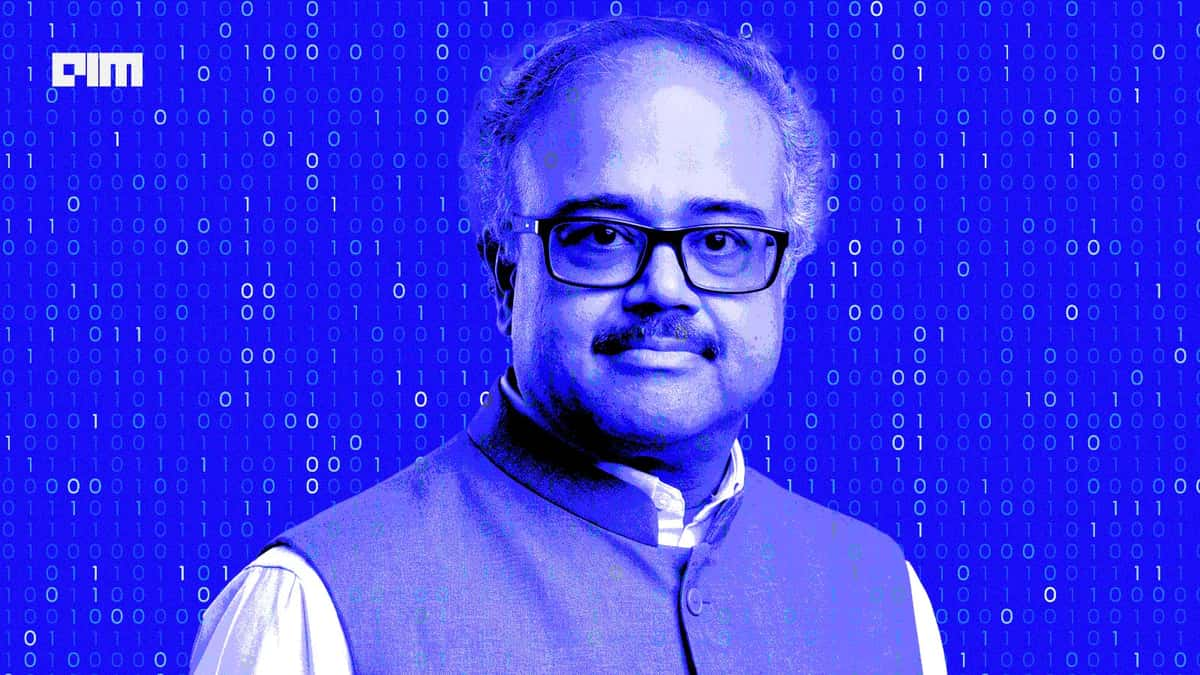
IIT Madras Professor Balaraman Ravindran believes India should resist the temptation to blindly follow the path laid out by the world’s AI leaders. He believes that India’s biggest opportunity lies in building scalable applications, strengthening semiconductor capabilities, and creating a UPI-like ecosystem that can deploy AI at a population scale.
In an exclusive interview with AIM, Ravindran, who was appointed to the United Nations’ Independent International Scientific Panel on Artificial Intelligence in February, says the panel’s primary objective is not to shape policy but to provide an unbiased, evidence-based understanding of AI and its impact on society.
The panel consists of 40 members drawn from different countries and disciplines. “It’s been a very mixed set of people,” he says. “There are journalists, psychologists, environmentalists, and people from different walks of technology and society who will be impacted by AI.”
It will examine AI’s impact on sectors such as healthcare, employment, information technology, mental health, and women’s and children’s safety, and publish annual reports on its findings.
‘India Shouldn’t Copy OpenAI’
The last few days have seen a growing debate over India’s AI ambitions to build a frontier sovereign LLM, especially after Anthropic banned the Fable model for foreign nationals, citing security concerns. However, Ravindran believes India should resist the temptation to blindly join that race.
“We really have to take a look at what makes sense for India and not run the race blindly,” he says, adding that India needs to figure out the correct pathway to compete with the likes of OpenAI.
While acknowledging the rapid pace of global AI investment, he questions whether matching the spending levels of companies like IPO-bound OpenAI and Anthropic would be the most responsible approach for India. However, Ravindran opines that India should think carefully about what its AI stack should look like, taking into account constraints around investment, infrastructure, deployment, and scale.
India’s Opportunity Lies in Applications
When asked where India can realistically compete, Ravindran points to the country’s history of building digital public infrastructure.
He drew parallels with systems such as Aadhaar and UPI, which were not based on inventions originating in India but were transformed through innovative engineering and large-scale deployment. “We took it to a different level,” he remarks.
The challenge now, he believes, is finding the AI equivalent of UPI. Ravindran says the solution could involve an open-source model, a proprietary model, or even one developed domestically. He adds that India may not necessarily need a frontier model, as older deep learning architectures and simpler transformer-based models could also prove effective if they can deliver results at scale. “There are a lot of these hard questions that we have to ask if we’re going to actually get AI to impact the next billion population in the country.”
Balaraman says that Indian AI companies have not yet caught up with Western frontier models. Referring to Sarvam AI, he says the company chose to address a specific subset of problems relevant to India rather than attempting to outperform leading global models across every benchmark. It is building valuable foundations for enterprise AI applications and local deployment rather than pursuing dominance in consumer chatbots.
Sarvam AI recently entered the unicorn club after raising $234 million in a funding round led by HCLTech, valuing the Bengaluru-based startup at $1.5 billion.
Agentic AI Can Transform Scientific Research
Among recent developments in AI, Ravindran says the area that excites him most is not consumer chatbots but agentic workflows for scientific research.
He believes AI agents have the potential to fundamentally change how scientific discovery is conducted. “The kind of step change in what scientists can do is really exciting.”
While acknowledging that agentic systems still suffer from bugs and reliability issues, he sees enormous potential in their long-term impact on research and innovation.
Have LLMs Hit a Wall?
The industry has repeatedly debated whether large language models are approaching the limits of scaling. Ravndran remains cautious.
“Every time I say that we have hit a wall, something clicks.”
He points to advances in inference-time learning, representation learning, and model efficiency as examples of innovations that continue to improve model capabilities.
However, he believes the next major leap will likely require something beyond simply scaling today’s architectures.“I don't know if just pushing the boundary on LLMs alone is going to get us that next step change in capabilities.”
Drawing parallels to the transition from traditional machine learning to deep learning and later to transformers, he says that future progress may depend on entirely new paradigms rather than incremental improvements.
Why Most AI Startups Remain Vulnerable
Balaraman also warns that many AI startups face an existential challenge because advances in foundation models can rapidly eliminate entire product categories.
“One of these bigger companies comes out with a small tweak to the model and then releases the next version of the model. Around 80% of the startups suddenly find that their business case has vanished,” he notes.
For startups seeking defensible advantages, he says proprietary datasets and deep domain expertise remain a potential moat. “If you have access to large volumes of healthcare data on a specific medical condition, then the AI you build by fine-tuning on that data is what is going to give you the moat.”
Semiconductors are a National Security Priority
Ravindran also highlights the strategic importance of semiconductors, especially as countries increasingly view chip manufacturing as a matter of national security.
India recently bagged major semiconductor investments, including Tata Electronics’ ₹91,000 crore chip fabrication plant in Dholera, Gujarat, and a ₹27,000 crore semiconductor assembly and testing facility in Assam. While the country remains behind global leaders, Ravindran believes such investments are essential for building long-term self-reliance in critical technologies.
“At some point, we have to become self-sufficient because it’s become a matter of national security,” he adds.
However, he cautions that semiconductor leadership cannot be achieved overnight. “We are waking up to it, we are investing quite a bit, and the government also has made it a critical sector and area of priority.”
Ravindran concludes that India’s AI challenge is ultimately not about matching every breakthrough. He believes India’s path forward lies in frugal innovation, scalable deployment, public infrastructure, and real-world impact.
Rather than trying to win the same race as the United States and China, India may have a better chance of creating an entirely different track.
- The AI Slowdown Narrative Doesn’t Reflect Enterprise Reality
- India’s Enterprises are Scaling AI. Is the Infrastructure Ready?
- Industry Wants Faster Approvals and Cheaper Power in India’s Data Centre Policy
- Inside Jio Platforms: Its Tech Bets, Loss-Making Subsidiaries and Hidden Risks
- India’s GCCs to Add 1.4 Million Jobs, Drive 170 Million Sq. Ft. Office Demand by 2031
- AI Can Be Cyborg or Centaur. But Can Enterprises Monetise It?