
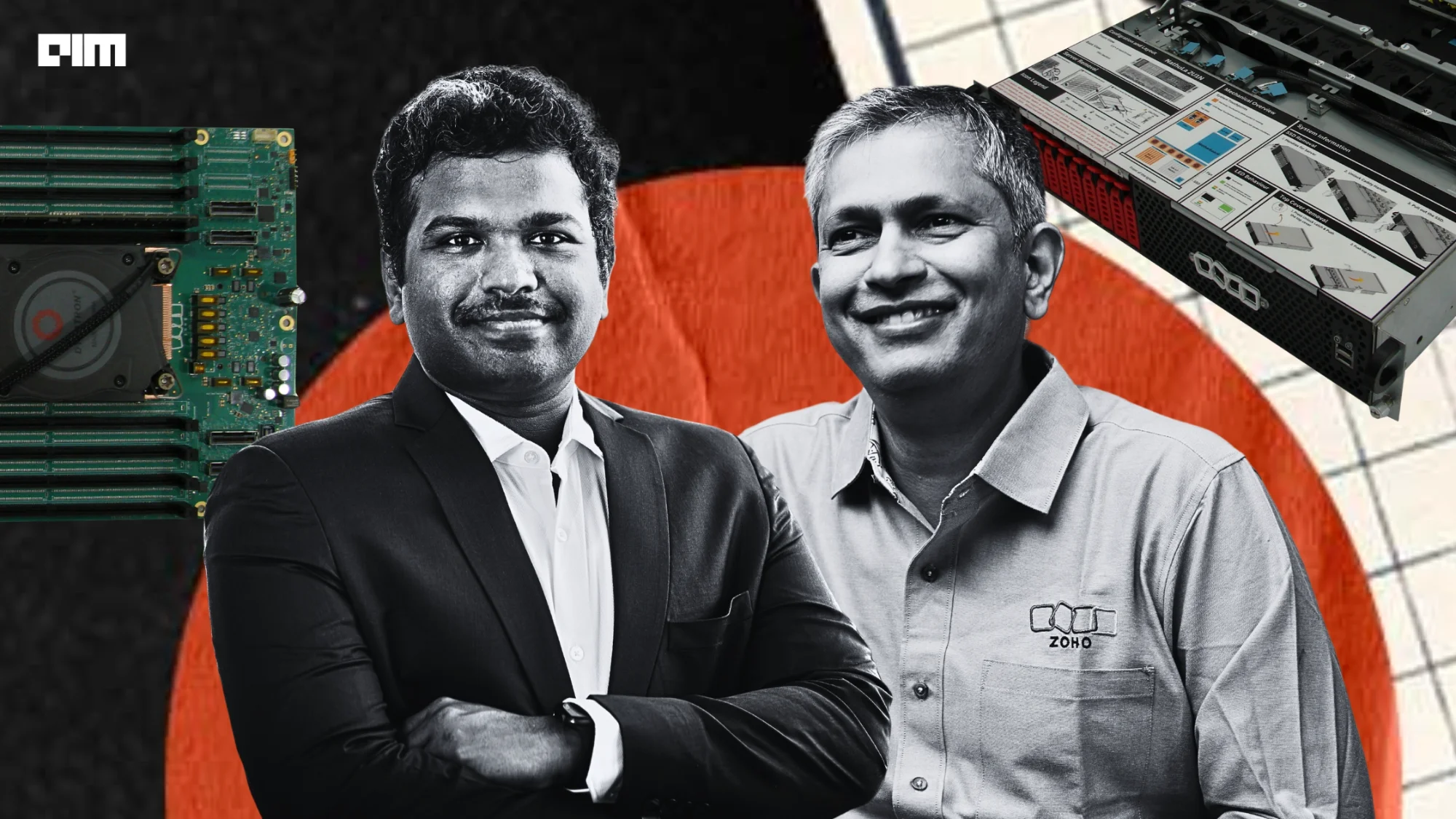
Zoho has built its own server. The announcement sounds incremental. It is not.
The company has unveiled Nathu La, a designed-in-India server platform that delivers 12% to 18% lower power consumption and 20% to 30% lower total cost of ownership. It is based on Intel Xeon 6 processors and was developed at Zoho’s Nagpur R&D centre.
But the real story is not the hardware. It is what pushed Zoho into hardware.
“The same server cost has gone up by 4x,” says Ramprakash Ramamoorthy, Director of AI Research at Zoho and ManageEngine, in an exclusive interaction with AIM. “It’s not a percentage, it’s a multiple.”
“Again, the idea is that Zoho runs on Zoho, like all our software tools today,” he said.
For most SaaS companies, compute used to be the third-largest cost after people and operations. By mid-2026, Zoho says compute has become the largest. The economics of software are beginning to resemble manufacturing, where equipment costs dominate.
This is the backdrop for Nathu La.
The name has its own story. Ramamoorthy recalls a family visit to Nathu La (pass), a high-altitude mountain pass on the India-China border. Bad weather conditions cut the journey short, but the place lingered in his memory. “It was an incomplete task, so when we were deciding on what name to give, Nathu La just popped in as a first name,” he recollects.

Zoho’s Full-Stack Argument
Zoho has always positioned itself differently from its SaaS peers. It has never taken venture capital, never listed publicly, and has built more than 100 products in-house. The company runs its own data centres and builds its own software stack.
Nathu La extends that philosophy into hardware.
“We believe in essentially having ownership on the full stack,” Ramamoorthy says.
The logic is simple. A typical SaaS company builds software but pays cloud providers for compute and model providers for AI capabilities. That structure worked when compute was cheap and predictable.
It no longer is.
Zoho’s answer is vertical integration: own the applications, own the models, own the infrastructure and now, own the servers.
The immediate goal is not to sell servers. It is to control cost, performance and reliability for Zoho’s own products.
“A customer is never going to feel Nathu La,” Ramamoorthy explains. “But the ultimate translation is customer value. We want to be a predictable company to do business with.”
Why Build a Server?
The trigger was not just cost. It was also the supply.
Over the last few years, server lead times stretched, prices surged, and access to hardware became uncertain. AI demand has only amplified this. GPUs are scarce, and even standard enterprise servers have seen sharp inflation.
Zoho’s response was to reduce dependence. The company started working on hardware in 2020 with a small team in Nagpur. Over five years, that effort grew into a full server platform covering chassis design, motherboard engineering and firmware.
Mangesh Sadafale, Head of Hardware Development at Zoho, describes the approach as modular. “When we are designing this server, we made it modular so that the server can be configured based on the end use,” he tells AIM.
That is where Zoho believes it gains efficiency over global OEMs.
General-purpose servers are built to support every possible workload. Zoho’s servers are built for Zoho’s workloads.
That distinction matters.
How Zoho Optimised the Hardware
The cost and power gains come from removing general-purpose overhead.
Sadafale gave a simple example. Storage systems in standard servers support multiple configurations across HDD, SSD, SATA and SAS. Zoho split this into two simplified designs, each built for a specific need.
“As a result, it is much cheaper, and we know that this design is being used by us only,” he says. This philosophy runs across the system.
The chassis is designed for Zoho’s data centres. The electronics are tuned for its workloads. The firmware strips out unnecessary layers. The result is a server that does fewer things, but does them more efficiently.
Zoho has already deployed 1,000 to 2,000 units in pre-production across its data centres. The company says the system is optimised for virtualisation, storage, HPC and AI inference workloads.
The AI Layer: Right-Sizing Over Scale
The server strategy is tightly linked to Zoho’s AI approach. While much of the industry is chasing larger models and more GPUs, Zoho is pushing a ‘right-sizing’ strategy.
“A lot of companies today just slap an LLM on top of their products,” Ramamoorthy adds. Zoho, instead, uses a mix of small, medium and large models depending on the task. Many workflows, the company argues, do not need large models at all.
A receipt extraction task can run on a small model. Background blur in video calls can run on the user’s device. Many enterprise workflows are predictable and repeatable, making them better suited for smaller, CPU-based models.
GPUs are used where necessary, especially for reasoning-heavy tasks such as agent workflows and API orchestration. But the goal is to minimise dependency.
This has direct cost implications. “With AI advancements, inference costs are rising rapidly,” Zoho said in its announcement. Running smaller models on owned infrastructure compounds cost savings.
The company’s internal experiments reinforce this view.
Ramamoorthy describes how large-model deployments often failed to deliver real productivity gains, even when they performed well in benchmarks. The biggest improvements came from connecting workflows and systems rather than scaling models.
“It’s not about the bigger model,” he says. “It’s about the strategically connected back office and front office.”
Building Talent Outside Metro Hubs
One of the more unusual aspects of Nathu La is where it was built.
Zoho’s hardware team operates out of Nagpur, not Bengaluru or Hyderabad. The company built its own talent pipeline through a programme called SETU, which trains engineering students in hardware design. More than 300 students have gone through it.
Hardware talent, Zoho says, is far harder to find than software talent. Building servers required training engineers from first principles.
“Hardware is hard,” Sadafale says. The company’s model pairs experienced engineers with fresh graduates and builds capability over time. It is slow, but aligned with Zoho’s broader philosophy of patient capital.
What Nathu La Is Not
For now, Nathu La is not a commercial product. Zoho is not positioning itself as a competitor to Dell, HPE or Supermicro. It is also not building its own silicon.
Sadafale was explicit on this point. The company will continue to use processors from suppliers like Intel and AMD. “At this stage, our step is to build a system, not the silicon.”
Zoho’s separate investment in Netrasemi, which focuses on edge AI chips, is unrelated to Nathu La. The roadmap is incremental.
First, deploy internally. Then refine. Over time, potentially offer the platform for on-premise deployments bundled with Zoho software.
There is no pricing, no timeline and no commercial push yet.
The Larger Shift
Nathu La signals a broader shift in how software companies think about infrastructure. As AI workloads scale, compute is no longer a commodity. It is a strategic asset. Zoho’s answer is to go deeper into the stack.
The company is not alone in this direction. Hyperscalers have already built custom hardware and chips. What makes it different is that a SaaS company is now following that path.
The bet is that control over infrastructure will translate into cost advantages, performance gains and long-term stability. It is also a bet that the current AI cycle will reward efficiency over brute force.
“We want to be a predictable company,” Ramamoorthy says. In a market defined by volatility, that may be Zoho’s most important claim.
Nathu La is not just a server. It is how Zoho plans to survive the next phase of AI.

Your reaction