

Retail Media Networks have become the fastest-growing channel in digital advertising, with projections placing the US market at nearly $70 billion by 2026.
What began with sponsored listings on retailer websites has expanded into a fragmented ecosystem spanning onsite search, programmatic offsite, connected TV, paid social, in-store screens, and CRM-triggered campaigns.
However, the measurement has remained unchanged.
The Problem
Consider a typical consumer journey. A shopper sees a sponsored product on a retailer’s app on Monday, a CTV pre-roll on Tuesday, an Instagram Story on Thursday, and a promotional email on Friday, before making a purchase the following week. Which of these interactions should receive credit?
Today, the answer is all of them.
Differences in attribution windows alone can create a 50–80% variance in reported Return on Ad Spend (ROAS) for the same campaign across networks. When reports from multiple partners are aggregated, the total number of “claimed” conversions often exceeds actual sales by 200–400%. The result is a system that inflates performance while eroding trust. Only 6% of advertisers say they trust the media metrics retailers report.
This is not a data quality issue. It is structural. Each channel operates its own attribution model, with its own rules and incentives, and no shared framework to reconcile outcomes.
The Real Question No One Is Asking
The industry continues to ask which channel drove the conversion. That is the wrong question.
The more relevant question is whether the conversion would have happened anyway. What matters is not credit allocation, but causality.
This is where incrementality becomes critical. It measures the difference between what would have happened without media intervention and what happened because of it. It is the only metric that directly connects advertising to real business growth.
That shift in thinking is already underway. Today, 71% of advertisers rank incrementality as their most important KPI for retail media success, ahead of traditional ROAS. Yet 44% still express concerns about the accuracy of the results they receive. The intent to measure correctly exists; the infrastructure does not.
What Getting Measurement Right Actually Requires
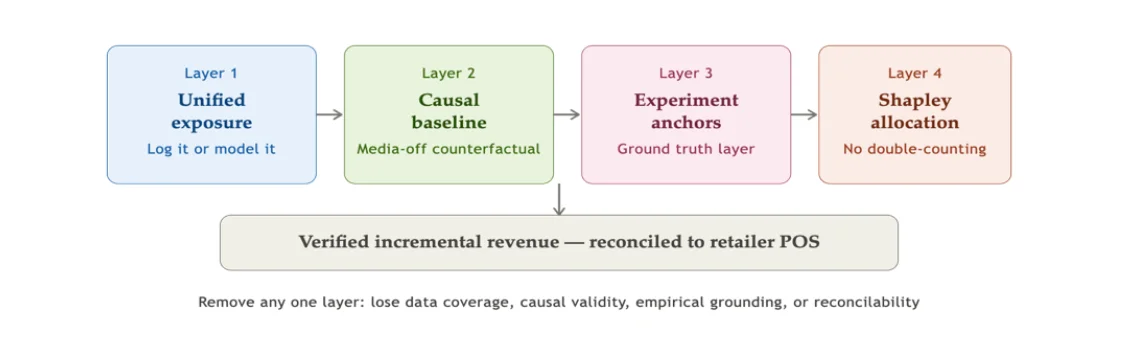
Fixing this needs a different measurement architecture, not more data, to reconcile imperfect signals into a credible view impact.
At its core is a unified exposure layer, where every media interaction is recorded in a consistent format before any attribution logic is applied. Incomplete data, common in environments such as CTV, in-store, and off-site channels, must be treated as a modelling challenge rather than a limitation. No channel should gain an advantage simply because it is easier to measure.
Equally important is establishing a credible counterfactual. Attribution without a baseline is not measurement; it is correlation dressed up as insight. A robust system constructs a “media-off” scenario using geo-clustered markets with varying levels of investment, shifting the focus from whether sales followed exposure to whether additional sales occurred as a result.
Controlled experimentation anchors the framework. Holdout tests, geo-based blackout experiments, and A/B suppression studies provide the most reliable signals of causality. Their outcomes serve as ground truth, continuously calibrating and validating probabilistic models. Without this layer, measurement remains speculative.
Once the total incremental impact is established, the next challenge is distributing credit across channels without double-counting. Shapley value allocation, borrowed from cooperative game theory, addresses this by assigning a value to each channel based on its marginal contribution across all possible media combinations. The results are often counterintuitive.
Channels such as CRM email, retargeting, and branded search, which appear highly efficient in last-touch models, frequently contribute little incremental value. They capture demand effectively, but do not necessarily create it.
What This Unlocks for Retailers and Brands
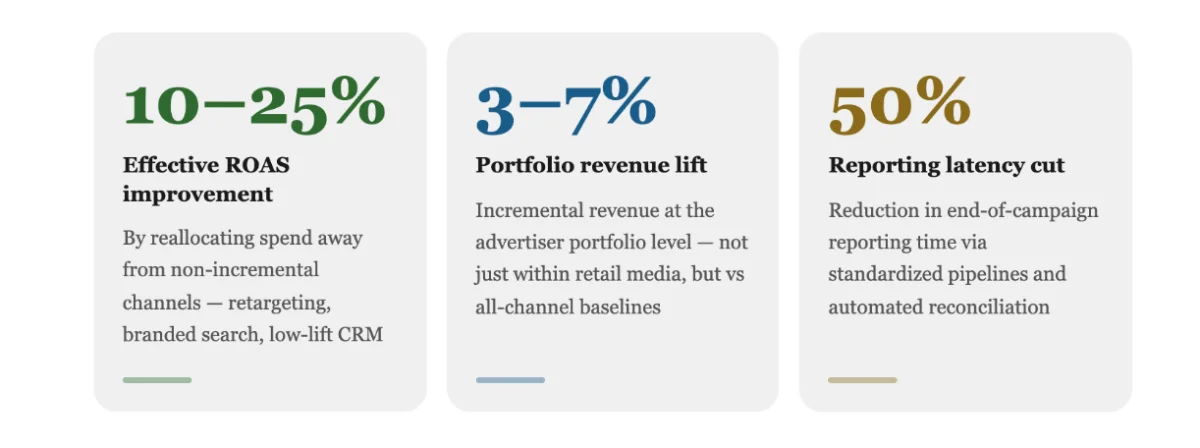
Organisations that shift from attribution-based reporting to incrementality-led measurement tend to see consistent improvements in media efficiency, budget allocation, and revenue growth. The gains are not theoretical; they are repeatable.
This is not about analytical sophistication for its own sake. It is about ensuring that the tens of billions of dollars flowing into retail media deliver measurable, defensible returns.
The tools already exist. The methodology is proven. What remains is the organisational will to move beyond convenient metrics and demand measurement that can withstand scrutiny at the C-suite level.
Retail media does not have a performance problem. It has a proof problem.
The question is not whether your retail media investment is working. It is whether you can prove it.

Your reaction