Key takeaways
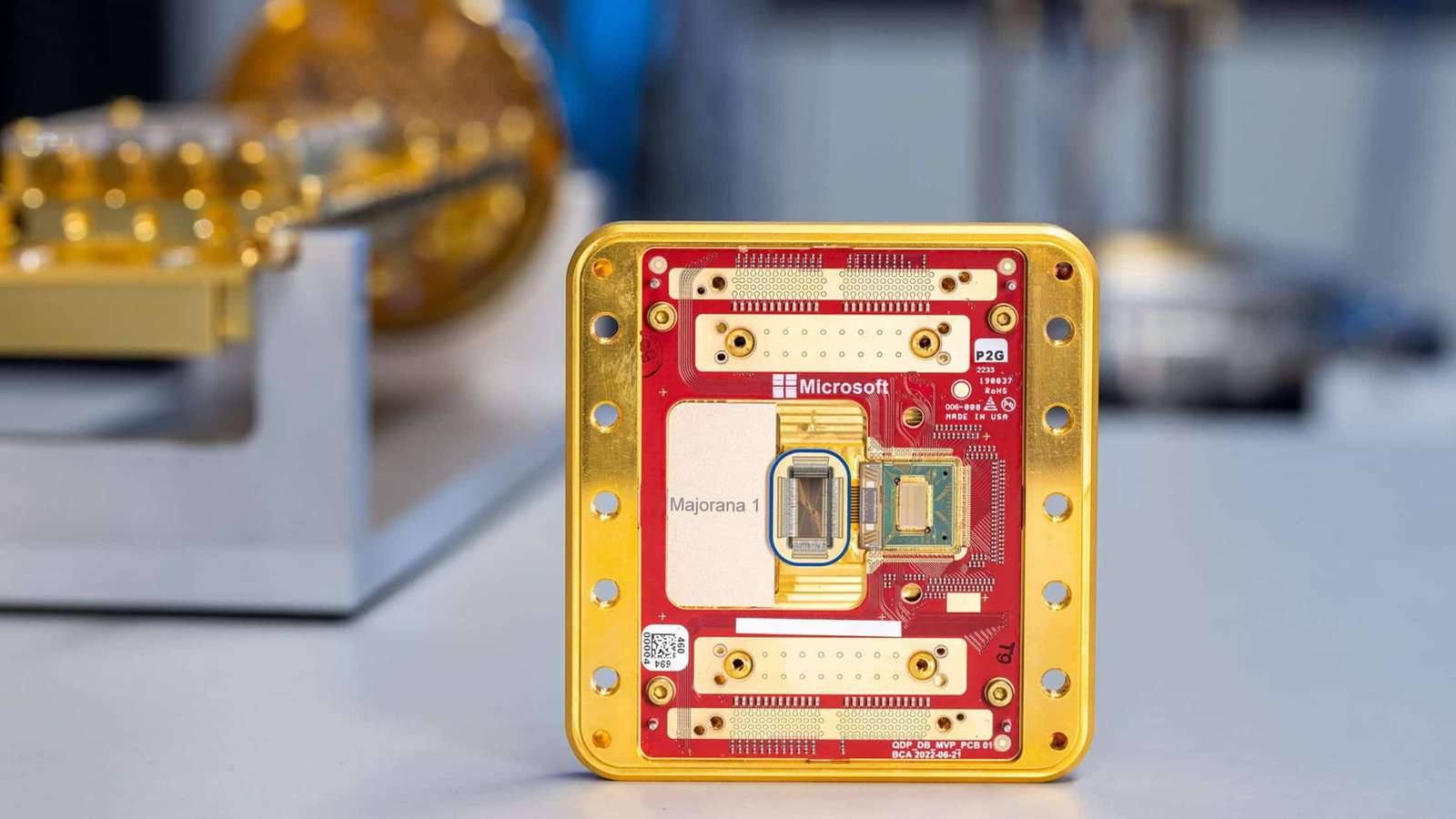
- Microsoft unveils Majorana 1, the world's first quantum processor using topological qubits.
- Majorana 1 chip can potentially hold one million qubits on a compact design.
- Microsoft plans in-house manufacturing of the Majorana 1, not available via Azure.
- Chip aims to solve industrial-scale problems beyond the capability of current computers.
- Satya Nadella highlights the chip's size and potential to revolutionize computing.
Microsoft announced the creation of the Majorana 1, claiming it as the world’s first quantum chip using topological qubits, on Wednesday. This represents a major step toward achieving practical quantum computing.
The company expects that this new chip will allow quantum computers to solve industrial-scale problems in the near future.
Satya Nadella, chairman and CEO at Microsoft took to X to express his views on the breakthrough as well.
He said, “They are 1/100th of a millimetre, meaning we now have a clear path to a million-qubit processor. Imagine a chip that can fit in the palm of your hand yet is capable of solving problems that even all the computers on Earth today combined could not!”
Microsoft has chosen to manufacture the Majorana 1 components in-house in the United States. The company has no plans to make the chip available to clients through Azure, unlike its Maia 100 AI chip.
The Majorana 1 uses a new ‘Topological Core’ architecture and can potentially hold one million qubits on a single chip, which is just slightly larger than desktop computer CPUs.
Chetan Nayak, a technical fellow for quantum hardware at Microsoft expressed that the goal was to “invent the transistor for the quantum age.” He added, “The next step is a scalable architecture built around a single-qubit device called a tetron.”
In a recent discussion, Nayak expressed, “It’s gratifying to see something in nature that we have been thinking about for a long time and that people hypothesised for decades.”
This breakthrough, the result of nearly 20 years of research, uses a novel material called a ‘topoconductor’ or topological superconductor to control Majorana particles, leading to more reliable qubits. This material is of a special category that can create an entirely new state of matter – not a solid, liquid or gas but a topological state.
According to Microsoft, a quantum computer with one million qubits has the potential to address complex industrial and societal problems, such as breaking down microplastics or creating self-healing materials.
The Microsoft team behind the breakthrough explains behind the scenes of the processor:
In its official blog, the company mentioned the challenges it has faced over the years. Until recently, these exotic particles Microsoft sought to use (Majoranas) had never been seen or made. They don’t exist in nature and can only be coaxed into existence with magnetic fields and superconductors.
While companies like Google and IBM are also developing quantum processors, Microsoft’s Majorana 1 incorporates eight topological qubits using indium arsenide (a semiconductor) and aluminium (a superconductor).
Google’s recent quantum chip, Willow, took over the internet after its release for suggesting the possibility of a ‘multiverse’, even so, that it sparked a visionary exchange between Google CEO Sundar Pichai and SpaceX’s Elon Musk.
However, many critics questioned the tech giant’s bold claims, saying the tech giant’s claims were based on a flawed benchmark and that it has no real-world applications.
Spotted an error? Tell our editors. Read our editorial standards and corrections.