

Anthropic has improved the latency of Claude Code across multiple platforms.
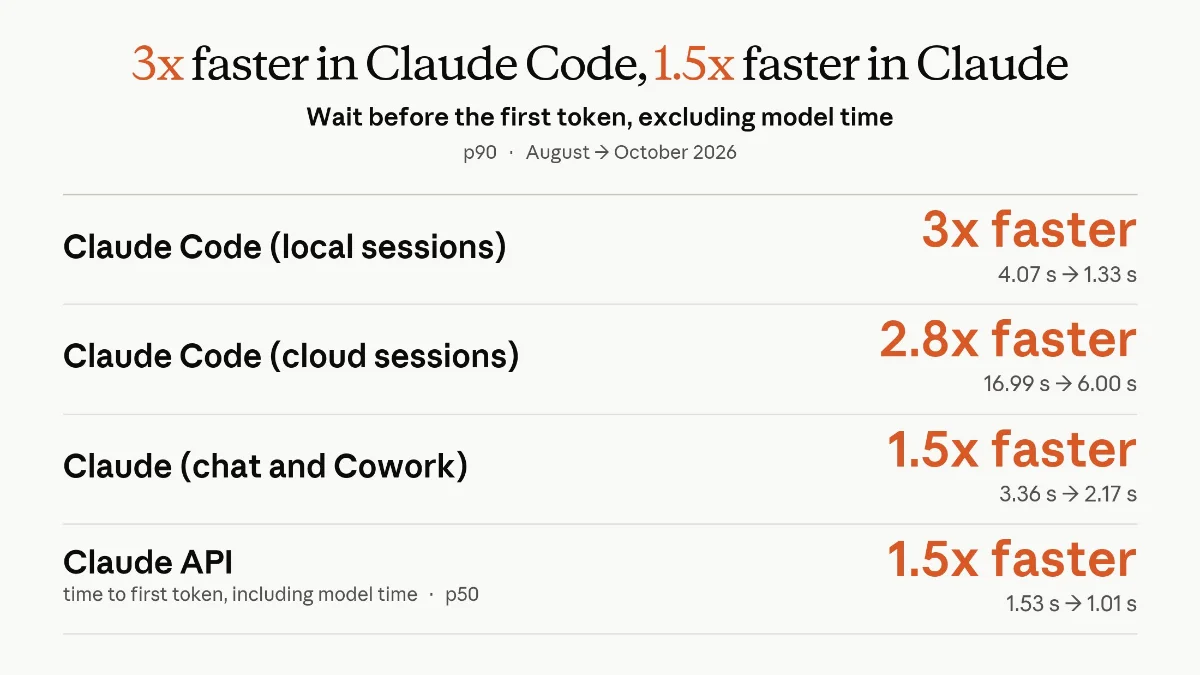
Compared to August, it is now 3x faster on local sessions, 2.8x faster on cloud sessions, and 1.5x faster on API, chat, and Cowork platforms.
The company used gzip, a data compression utility released in 1992, to improve performance.
“Claude Code now gzips the conversation it sends on every turn, so it reaches the model faster,” said Anthropic in a post on X. “Cloud sessions also start up as soon as you start typing.”
These improvements are measured at the 90th percentile (p90) for the wait before the first token, excluding model processing time—meaning it likely isolates delays from factors such as conversation transmission and session startup.
The Claude API figure is different, as it measures median (p50) time to first token, including model processing time.
Gzip was created by Jean-Loup Gailly and Mark Adler as a free alternative to Unix's compress utility, whose LZW algorithm was subject to patents. First released in October 1992, gzip remains widely used to compress data for storage and transmission.
These improvements follow last month’s 3x performance boost for Claude on desktop and web
Anthropic said a two-week engineering sprint merged more than 3,000 changes to speed up Claude’s web and desktop interfaces.
At the 75th percentile, loading Claude.ai to a typeable page fell from 3.1 seconds to 0.55 seconds.
Recently, Anthropic launched newer variants of the Opus, Sonnet, and Haiku models
Opus 5.5 targets agentic coding and professional knowledge work, performing at the level of Claude Fable 5.1 on most tasks while costing 40% less to run than Opus 5.
On the other hand, Sonnet 5.5 runs more than 30% faster and costs up to 30% less for most work, while Haiku 5.5 targets high-volume, cost-sensitive workloads.

Your reaction
Discussion
What's your take on this story?
No comments yet — be the first to share your view.