

India’s deeptech ecosystem is increasingly moving into physical automation. Among the startups attempting to redefine industrial work through robotics is Bengaluru-based Flo Mobility, which builds autonomous robots for the construction industry, a sector long considered resistant to technological disruption.
Founded in 2021, Flo Mobility initially started out with a different vision. The company originally focused on building autonomous navigation kits to retrofit on existing machines. But after experimenting across sectors, including agriculture, delivery, and facility management, the founders realised the approach was difficult to scale.
“We realised that’s not going to scale because there’s a lot of dependency on the underlying vehicle itself,” Co-Founder and CEO Manesh Jain tells AIM. “We have to do a fully vertically integrated, use-case-intensive robot.”
Why Construction Became the Focus
As Flo Mobility evaluated industries where robotics could solve large inefficiencies, construction emerged as a major opportunity. India’s construction robots market is growing at a CAGR of 18.9% and is projected to reach $193 million by 2030, per Grand View Research.
Jain says he and co-founder Pratik Patel identified a growing mismatch between rising infrastructure demand and labour productivity challenges across global markets.
Unlike warehouses or factories, construction sites are fragmented and unpredictable. Terrain conditions constantly change, workflows vary daily, and manual labour still dominates operations. Flo Mobility identified material movement inside construction sites as one of the biggest inefficiencies.
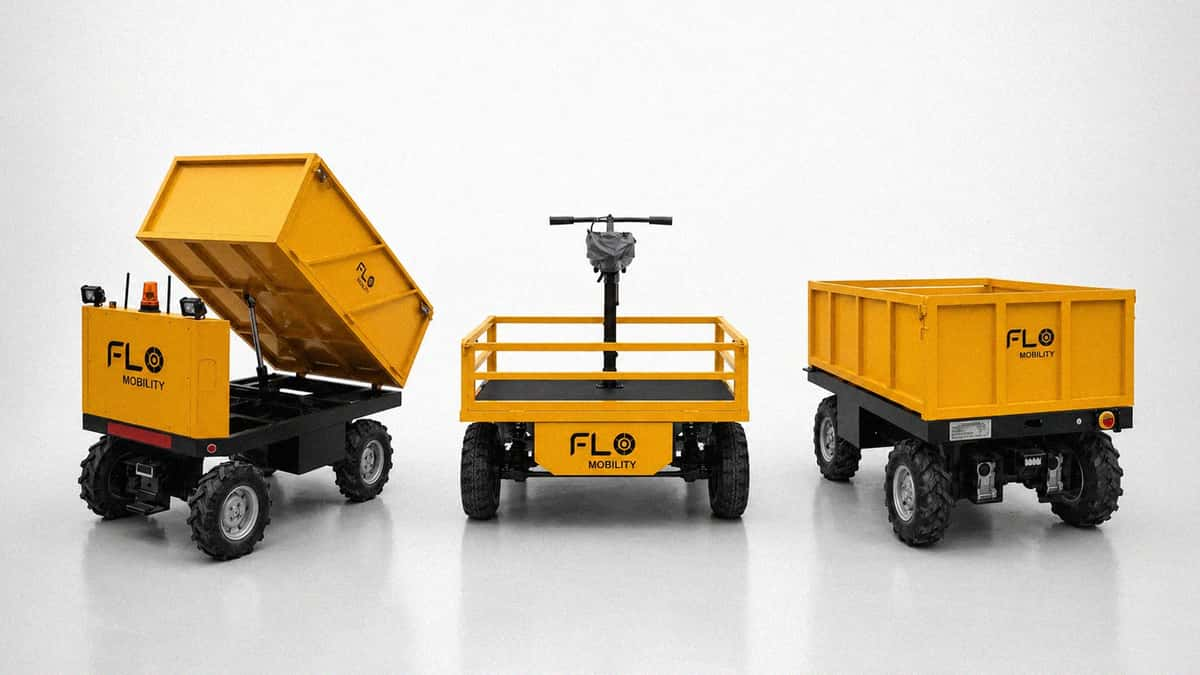
That insight led to the development of the Flo Hauler, an autonomous material transport robot designed for rough terrains and cramped construction environments. The robot carries payloads of up to 500 kilograms and is engineered to navigate slopes, slurry-filled sites, loose sand, and uneven surfaces.
Over the last two years, the company scaled deployments to nearly 70–80 machines across 15 Indian cities and worked with customers including L&T, Sobha, and Godrej. It also expanded into Dubai and Abu Dhabi, and is currently preparing for a wider West Asia and US expansion.
Building Robots for Unstructured Environments
Flo Mobility had to build systems capable of functioning both indoors and outdoors, across unfinished terrains where layouts and workflows changed constantly. Jain says the startup simultaneously solved for rugged hardware, embedded control systems, and autonomous navigation.
The company developed its navigation stack using GPS, LiDAR, cameras, and proprietary control systems. A major challenge, however, was the lack of publicly available datasets for construction robotics.
To overcome this, Flo Mobility adopted an approach similar to Tesla’s Full Self-Driving data strategy. The company initially deployed remotely controlled machines at customer sites while collecting operational data in real-world environments.
“We relied on our own datasets,” Jain says.
That data became the foundation for Flo Mobility’s AI models and intellectual property. The startup filed its first patent in 2021 and received the grant in 2024, while two more patents remained under review.
Jain says customer feedback fundamentally shapes the product roadmap. Instead of building products in isolation, the startup continuously tested and iterated on machines at live construction sites.
That close collaboration also pushed Flo Mobility toward a robot-as-a-service model. Nearly 70% of deployments currently operate through rentals, while the remaining 30% are direct sales. The approach reduced upfront adoption risk for customers while giving the startup continuous operational feedback and machine data.
Funding, Revenue and Global Expansion
Flo Mobility’s rental model required substantial upfront capital, since the company retained ownership of most deployed machines. To address this, the startup worked with leasing partners that purchased robots and leased them back to Flo Mobility.
The company raised funding across multiple rounds over the last four years. Early backing came from IISc-incubated ArtPark, along with angel investors and micro-VCs. More recently, Flo Mobility raised a $2.5 million pre-Series A round led by Mela Ventures and Arali Ventures.
The startup will use the fresh capital to support global expansion, product development, and scaling deployments.
According to Jain, customers are already witnessing significant cost savings through automation. Flo Mobility claims its robots help reduce operational costs by 40–50% by moving larger volumes of material faster and more efficiently.
Beyond India, the company saw a large international opportunity. Jain argues that labour shortages and construction inefficiencies are universal problems affecting markets, including the US, Europe, and West Asia.
“Construction customers need a lot of handholding,” Jain says. “Just giving them a machine and asking them to figure it out does not work.”
He believes Indian startups hold an advantage because of their experience in systems integration and adapting products to customer workflows.
The startup says its topline is growing at a compound annual growth rate of 66%, earning ₹2.4 crore ($250,000) in FY26. It has an order pipeline of ₹4.5 crore ($470,000) for the current fiscal year.
Competition, Challenges and the Road Ahead
While several startups like Addverb Technologies and CynLr entered autonomous mobility and industrial robotics, Flo Mobility differentiated itself by focusing specifically on rough-terrain construction autonomy rather than structured warehouse environments.
Jain says the company’s biggest moat lies in its AI stack and real-world operational data collected over years of deployments. “The AI piece, where the robot can perceive the world and still operate despite constant changes, is very difficult to copy,” he says.
The company, however, still faced multiple operational hurdles. Several critical components, such as motors, batteries, and sensors, were sourced through Indian vendors but continued to depend on imports from countries including China, Japan, and Germany.
Certification also emerged as an early challenge because battery-powered autonomous wheelbarrow-style robots did not fit neatly into existing industrial equipment categories. Flo Mobility eventually secured CE, ISO, and TPI certifications after months of regulatory navigation.
Talent retention remained another concern. Jain says robotics startups in India still struggle to compete with mature global markets for experienced engineers. As a result, the company focused heavily on internships and nurturing early-stage talent internally.
Flo Mobility currently operates with a 25-member team and is hiring across AI, engineering, and operations roles.
Looking ahead, the startup plans to expand in three directions: increasing payload capacity, building additional construction-focused robots, and entering new global markets. It is already developing wall-finishing and screeding robots while targeting deployments across India, the Middle East, and the US.
Over the next three to four years, Flo Mobility aims to deploy 5,000 robots globally and build a revenue run-rate of $50–60 million, with ambitions to eventually touch $100 million through aggressive expansion.
For Jain, the broader opportunity extends beyond construction robotics. He believes the rise of physical AI, improving capital access, and growing ecosystem support have created the right conditions for India to build globally relevant robotics companies.
“The world is hungry for automation across industries,” he says. “Now is the time to go out there and build.”
- Drizz's AI App Testing Ambition Meets Reality
- How This Indian AI Unicorn is Disrupting Hollywood With Digital Humans
- The AI Underwriting Engine Behind Recur Club’s ₹500 Cr Festive D2C Capital Push
- Loan Collection in India is Still Largely Manual. This AI Startup is Changing That
- The Antithesis Approach to Breaking AI-Generated Code
- The Hardest Test for India’s AI Dream