
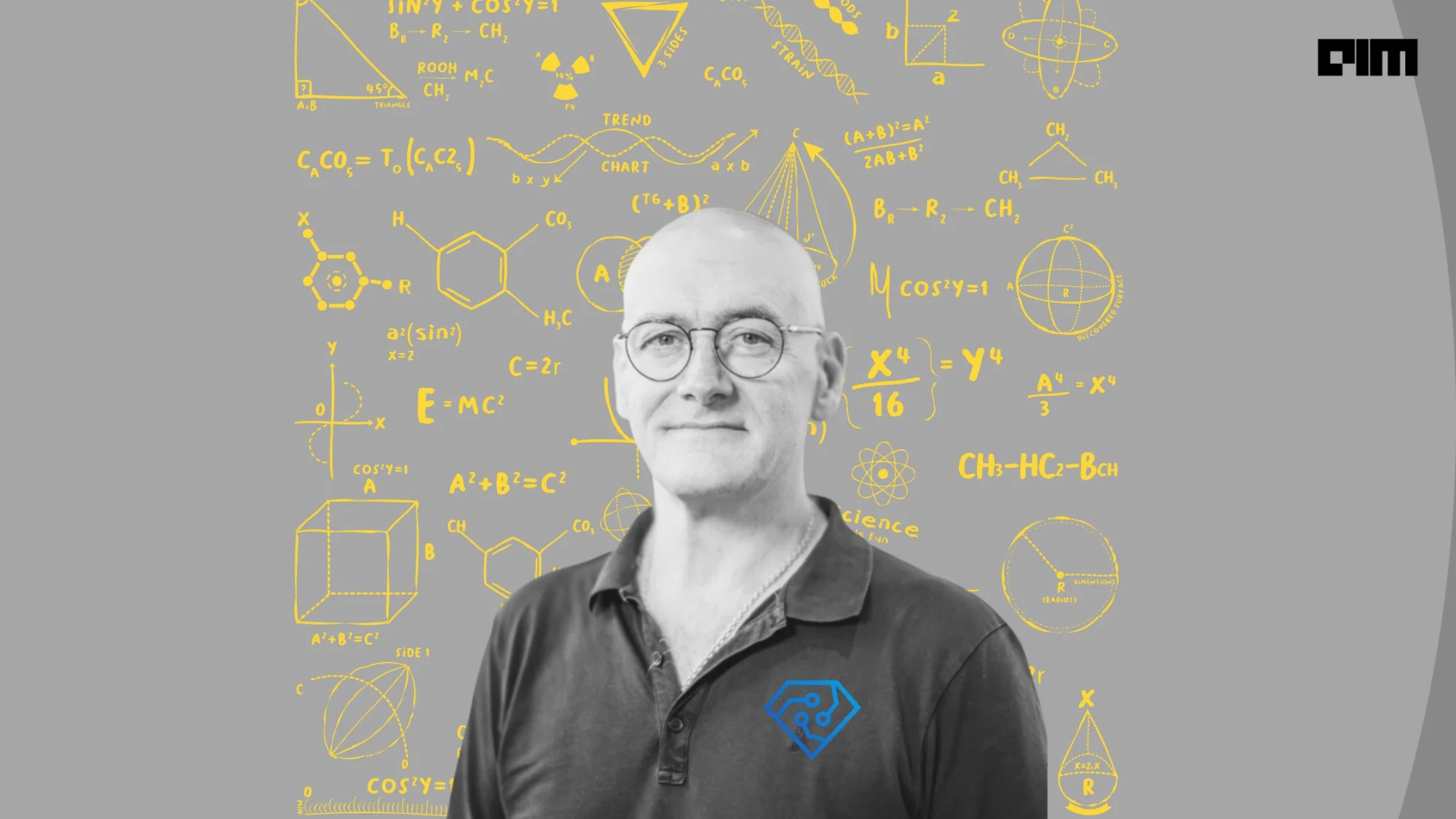
With a razor-sharp focus on room-temperature quantum computing and open-source QristalSDK, Quantum Brilliance is pushing the boundaries of what's possible in the revolutionary quantum field. “In Hindu mythology, there is Shiva that gives you coherence. When you make qubits, you need coherence, which means essentially convincing mother nature to give you energy,” said Mark Mattingley-Scott, chief revenue officer at Quantum Brilliance, in an exclusive interview with AIM.
“When you look at IBM, Google, or Amazon or any of these computer companies, you see these fantastic quantum chips that need lots of energy, lots of space. Essentially, all they're doing is creating something that gives you that coherence for a very short time,” he explained.
Quantum computing methods rely on complex infrastructure, massive energy consumption, and specialised cooling techniques to achieve the necessary conditions for qubits to maintain coherence. However, Scott explained how Quantum Brilliance takes a different approach by leveraging the unique properties of the nitrogen vacancy (NV) centre in diamonds. By utilising room-temperature diamonds, Quantum Brilliance unlocks the potential for using quantum computing in individual systems, instead of relying on the cloud.
“This means that you can install it on your own computer, and there are no issues of governance, sovereignty, or data protection as that is your possession now,” said Scott.
One of the distinguishing features of Quantum Brilliance’s quantum systems is their ability to operate at room temperature using synthetic diamonds. Unlike traditional mainframe quantum computers, these compact devices do not require cryogenic cooling, vacuum systems, or precision laser arrays. They consume significantly less power, making on-site or edge deployment feasible in any environment.

At present, Quantum Brilliance’s quantum computing technology is approximately the size of a desktop PC. However, the company is actively working on further miniaturisation, aiming to shrink their technology to the size of a semiconductor chip that can be integrated into any device, effectively making practical quantum computing universally accessible.
In 2019, Quantum Brilliance was established as a company that focuses on quantum products and solutions. Their primary objective is to develop diamond quantum computers accompanied by software and applications. It strives to facilitate the widespread adoption of its quantum technology, enabling various industries to leverage edge computing applications and advance into the realm of next-generation supercomputers.
The Qristal SDK provides developers with fully integrated C++ and Python APIs, along with NVIDIA CUDA features and customizable noise models, to support the creation of quantum-enhanced designs.
Startups ecosystem in quantum computing
Scott says that there are three segments of quantum — education, preparation, and integration. “The fourth step, which is performance, doesn’t exist yet. This means actually getting something useful.” Scott has worked with IBM in the past. He said that IBM has defined that narrative of quantum computing and it dominates the educational step of quantum computing. “You cannot yet put a quantum on a robot or a spacecraft, you need a cloud. That is why IBM dominates the market.”
Scott explains that most of the quantum computing business works in a similar way. “Let’s look at a customer's problem and see how many qubits can we provide to solve that problem,” he said.
“We are not interested in the first segment of education because we cannot compete with IBM,” said Scott. However, the company seeks to dominate the preparation and integration segments by offering unique solutions tailored to specific business problems. By providing quantum solutions that leverage a few dozen qubits and focus on replacing existing technologies with quantum alternatives, Quantum Brilliance carves out its niche and ensures its relevance in the evolving quantum computing landscape.
“When does the fourth segment start?”
Investing in quantum startups poses unique challenges due to the nascent nature of the field. The question of measuring return on investment (ROI) and predicting commercial use cases remains a significant concern. Scott said that it all boils down to the question of when quantum can become useful, the answer to which he said, “no one knows yet”.
“Some companies say that quantum will be adopted in the next five years. The same company said that five years ago as well,” said Scott. No one has a concrete idea about when quantum would be adopted by companies in the future. Scott emphasised that pinpointing the exact time when quantum repeaters will have a tangible commercial impact is elusive, but it would just be a handful of years.
India and quantum computing
“The thing about India that no one gets is the size of the talent pool and the willingness to accept new topics is humungous,” said Scott, talking about the potential India has in quantum computing. Instead of looking at the usefulness of quantum computing, Scott believes that India has the potential of finding business use cases for quantum computing and becoming a “600-pound gorilla of quantum applications”.
Every government in the world wants its own hardware when it comes to quantum. Scott says that the amount of money that the governments are putting into quantum computing is probably too small to rise above. “When you look at countries like Germany, which just pumped another $3.5 billion in the field after a $2.5 billion, it is clear that investing $100 million in quantum computing gives us no chance.”

Your reaction
Discussion
What's your take on this story?
No comments yet — be the first to share your view.