Not All Robots at the India AI Impact Summit were Chinese
By Sanjana Gupta ·
India’s manufacturing sector may be on the brink of a leap forward. But will that progress depend heavily on China? At the India AI Impact Summit 2026 in New Delhi, industry leaders and technologists flagged robotics and AI as immediate drivers of industrial change.
Yet, one of the most talked-about moments at the event was not technological progress, but a controversy. A social media backlash erupted when Galgotias University appeared to present Chinese robotics company Unitree Robotics’ quadruped robots as its own innovation.
The university later issued a clarification, stating, “Galgotias has not built this robodog, nor have we claimed so.” However, the statement raised further questions, given that the robot had already been showcased at the summit under the name ‘Orion’.
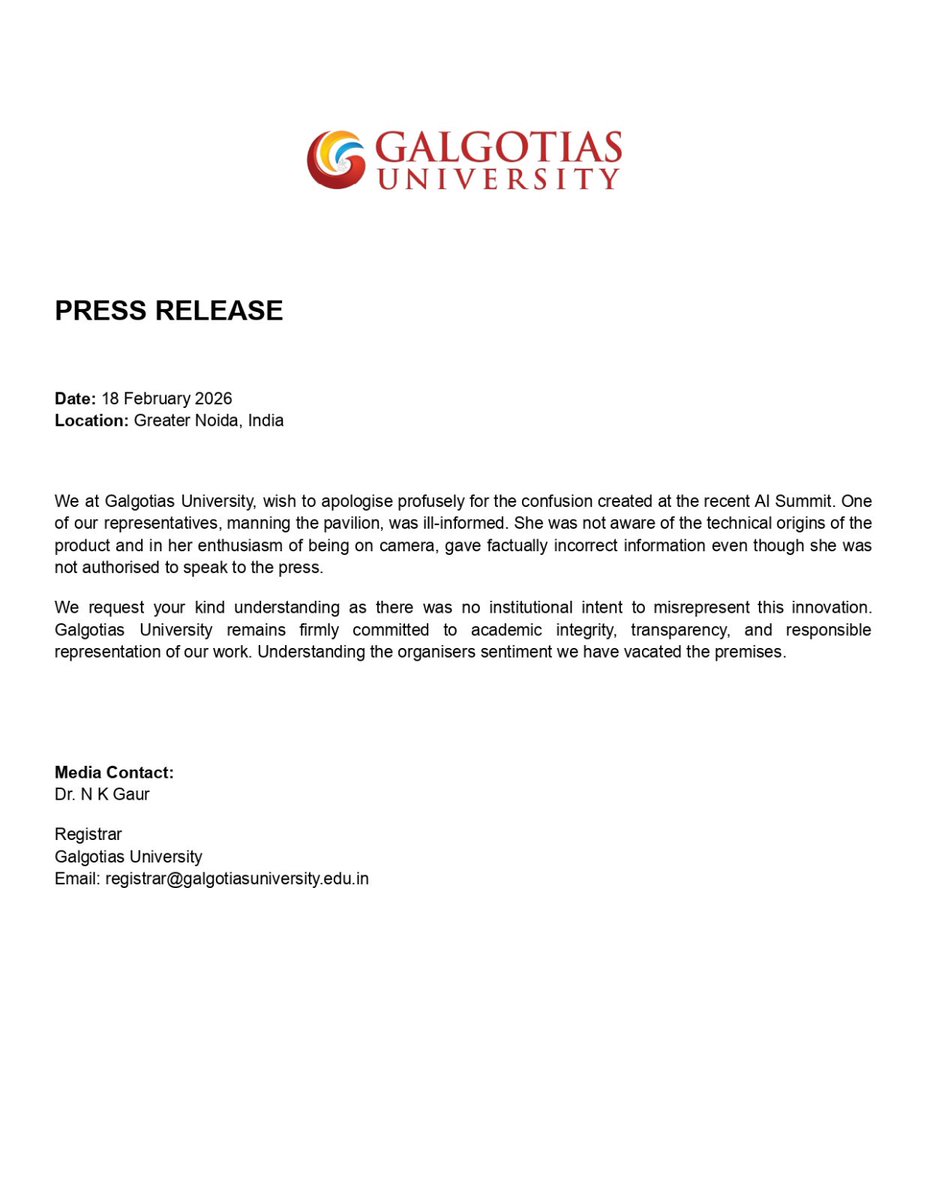
This episode exposed the widening gap between public perception and the realities of robotics development in India. As the incident went viral, the university was asked to vacate its stall at the summit. When the faculty allegedly refused, the electricity supply to the pavilion was reportedly cut off.
While promotional posts on academic achievements can build brand awareness, experts at the summit warn that misrepresentation can distort expectations among investors and the public alike. It also shows that, in a crowded innovation ecosystem, credibility matters as much as capability.
While this incident drew the attention of most robot enthusiasts, several other significant developments were underway at the summit.
Much Beyond Manufacturing
High-performance machines are already operating in real-world environments, and the event drew hundreds of companies, reflecting India’s ambition to scale automation across manufacturing, agriculture, and public services.
Chipmaker Qualcomm showcased a suite of robotics technology, including AI-powered humanoid robots and autonomous mobile platforms, marking a push into robotics computing at the show.
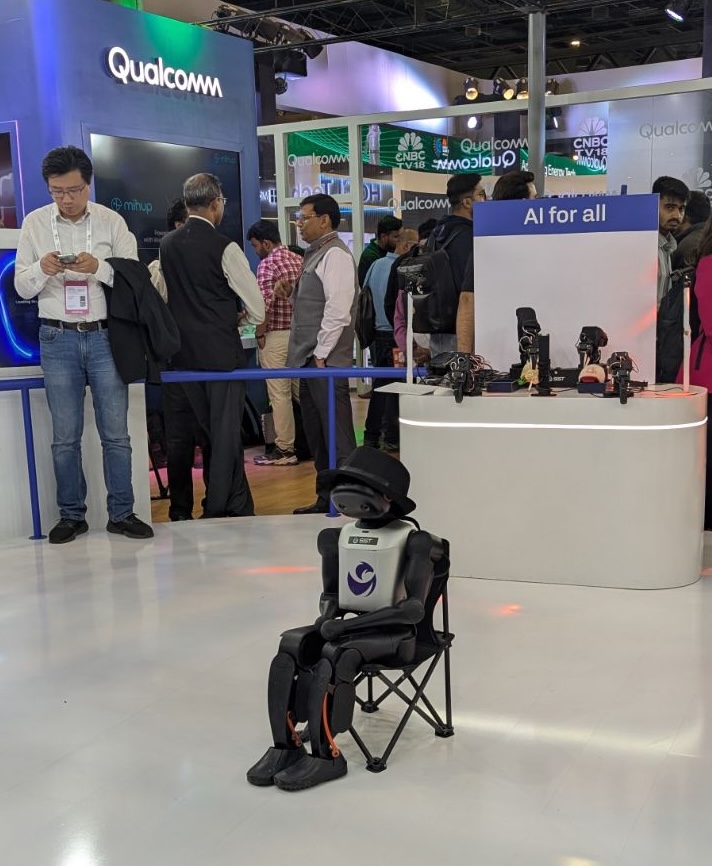
The company also introduced its Dragonwing IQ-10 processor, designed for advanced robotic workloads. Its Dragonwing QCS8550 powers the Booster K1 humanoid, which runs reinforcement-learning locomotion models entirely on-device. The robot showcased at the summit performs smooth, stable, rhythmic dance movements entirely on the edge, without any reliance on cloud processing.
With this, Qualcomm brings together heterogeneous edge computing, mixed-criticality AI, modular software, and an AI data flywheel to push physical AI beyond labs and into real-world deployment—from logistics and manufacturing to full-size humanoids capable of complex, task-based operations.
Smart agriculture also took centre stage. Technologies such as autonomous tractors, developed by Kubota and enhanced with AI by Agreenculture, are designed to perform field tasks without human drivers.
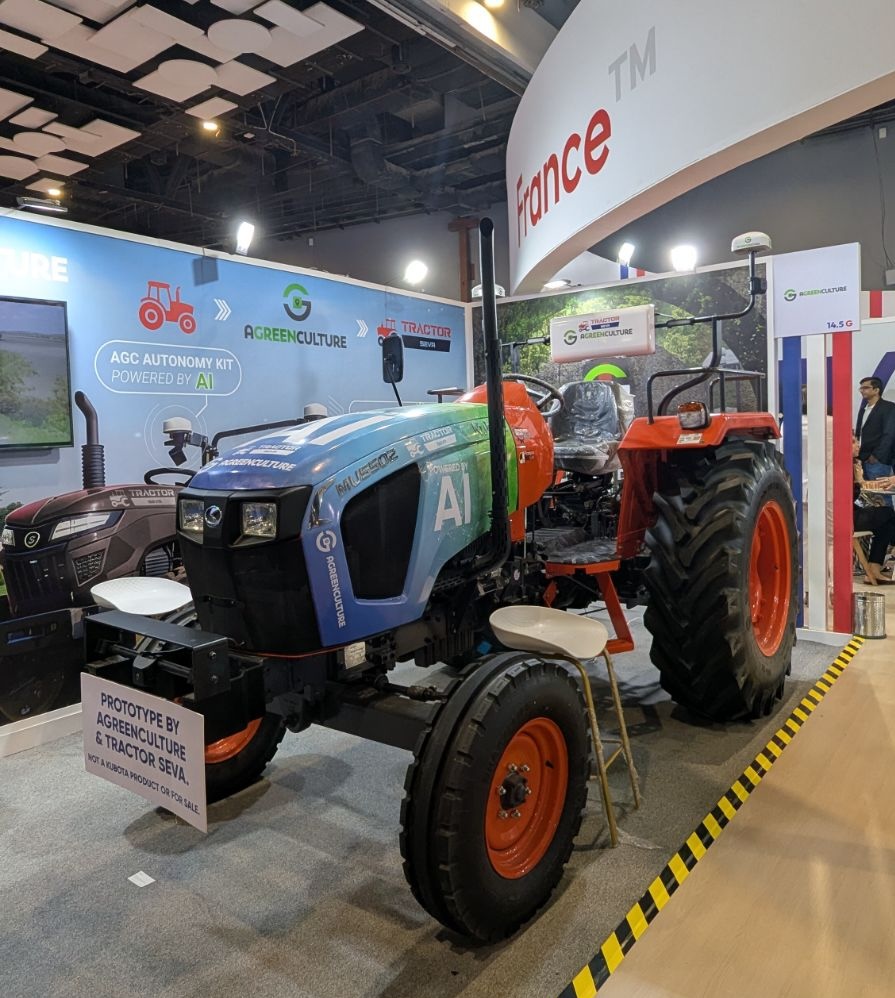
These machines can handle sowing, weeding and other labour-intensive tasks, potentially easing the physical burden on farmers while reducing exposure to risky conditions.
Kerala-based robotics startup iHUB Robotics also launched its Daksha Generation 2 humanoid robot at the summit. The company introduced the humanoid robot for industrial-scale deployment across enterprise and strategic sectors and claimed to have designed and developed the robot entirely in India.
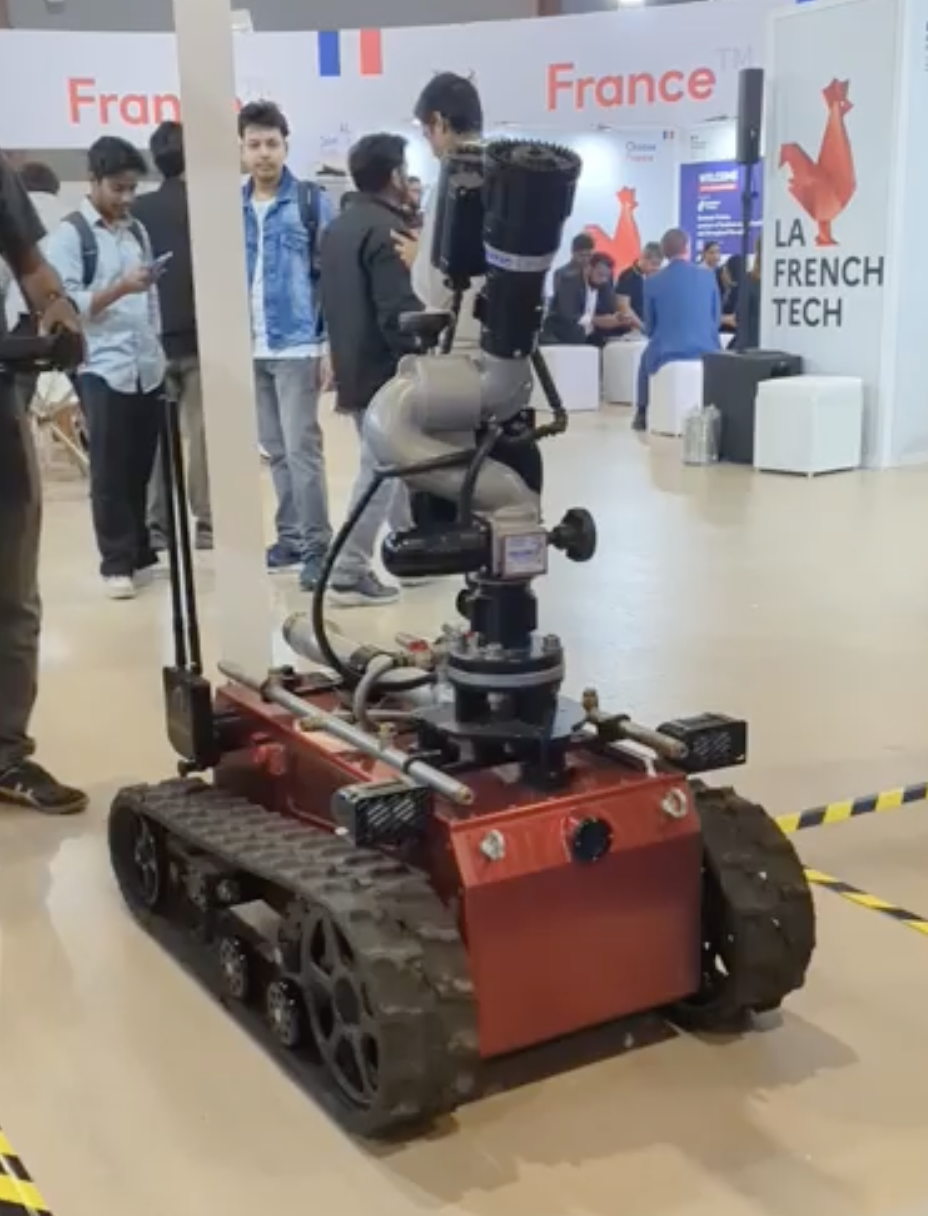
Emergency response robotics was another notable use case. Units such as the firefighting robot built by Shark Robotics in France are already deployed in parts of India, including Hyderabad and other districts in Telangana, to support fire departments in hazardous environments.
Construction-site monitoring added to the mix, featuring the Svan M2 commercial quadruped robot from Kanpur-based xTerra Robotics. The four-legged machine can traverse stairs, slopes and uneven terrain and carry equipment.
Witness Svan M2, India's first commercial quadruped robot at Booth 9, Hall 2 in India AI Impact Summit.
We are demonstrating real capabilities for construction site monitoring @narendramodi @AshwiniVaishnaw @adgpi @larsentoubro @IITKanpur @ihfc_tih @incubatorIITK pic.twitter.com/FAXkiUgMnn
— xTerra Robotics (@xTerraRobotics) February 18, 2026
These robots can also move through smoke and debris and relay visual and thermal data to human responders to reduce risks to life.
Meanwhile, other enterprise tech firms, such as EY, Tech Mahindra, and Wipro, also showcased robotic dogs at the convention. EY showcased a robot dog nicknamed EY Scout, designed for hazardous sites such as oil and gas facilities, offshore rigs and mines.
The robodog autonomously inspects alerts, streams live data to an AI analytics platform, and keeps humans out of danger, Arun Kumar Venugopal, Assistant Director, Robotics and Physical AI, EY, told AIM on the ground at the event. This robot, manufactured in China, is trained on EY’s in-house robotics software at its lab in Kochi, Kerala. The company is adding a seven-degree robotic arm for remote valve control, aiming to create a coordinated multi-robot ecosystem.
Practical Deployments are Essential
During a session titled ‘AI and Robotics: The Engine of India’s New Industrial Age’, leaders from industry, research and policy outlined how physical AI is finding its way into factories and fields. The emphasis throughout was on usable deployments rather than speculative research.
Amit Goel, Head of Robotics and Edge Computing Ecosystem at NVIDIA, says manufacturers are building production-ready solutions on platforms such as Isaac and Omniverse. He explains that these technologies help create “resource-optimised manufacturing ecosystems”, enabling companies to automate processes with lower upfront development overhead.
Goel says the immediate priority is to help India’s industrial base adopt these tools quickly—a theme reflected across the summit, where robotics demonstrations, where autonomous mobile robots and AI-enabled machines were visible on the expo floor.
Raghu Dharmaraju, CEO of the ARTPARK (AI & Robotics Technology Park) at the Indian Institute of Science (IISc), points to the need for practical outcomes when deploying robotics.
Founders and researchers, he says, must “deliver solutions that actually run on the factory floor.” That focus on real-world deployments resonates with industry players, as showcased machines go beyond prototypes into measurable use cases.
In the session, moderator Shashank Reddy of Evam Law & Policy also added that clearer rules and standards are necessary for wider adoption, noting that policy interventions can help companies invest in automation with confidence.
The panel also agree that workforce training must accompany technological growth. Goel says the goal is not simply to replace workers but to create new roles, adding that “innovation and workforce upskilling create high-value jobs.”
Time is Running Out
Reddy stresses that the challenge is not whether India adopts robotics but how quickly it can build infrastructure and skills to support it. While the controversy around a robotic dog exposed concerns about authenticity, panel discussions point to a deeper issue: urgency.
Goel argues that manufacturing expectations have changed. “What modern manufacturing requires is agility,” he says, explaining that factories must now update like software. Robotics and AI, in his view, convert manufacturing into “a software-defined problem,” allowing companies to iterate faster and maintain consistent quality.
There was also a clear safety warning. Physical AI does not get infinite retries. “You cannot just vibe check and send it out into the world,” Goel says, stressing simulation, digital twins and monitoring systems as essential safeguards.
For India, where most manufacturing sits with SMEs, this shift could be transformative. If production becomes software-driven, smaller units will no longer need massive scale to compete. They will need data, compute and the ability to deploy.