
Key takeaways
- AI advancements have led to the creation of fake news, complicating the fight against misinformation.
- Current fact-checking tools rely on manual verification, which may not keep pace with AI-generated content.
- The GROVER model aims to identify and generate news articles, enhancing the detection of AI-generated fake news.

 Fig: Grover detecting fake news
Framework
Grover can not only generate convincing fake news articles but also has the ability to spot its own generated fake news articles. The framework of this model is motivated by the current dynamics of manually created fake news. They are- Adversary: The goal of this method is to generate fake stories which will match specified attributes, i.e. being viral or persuasive. The stories must be realistic to both human users as well as the verifier.
- Verifier: The goal of this method is to classify news stories as real or fake. The verifier will have access to unlimited real news stories, but few fake news stories will be accessible from a specific adversary. This setup matches the existing landscape such as when a platform blocks an account or website, their disinformative stories provide training for the verifier; but it is difficult to collect fake news from newly-created accounts.
Architecture & Dataset
Grover, a new approach for efficient learning and generation of multi-field documents. Grover’s architecture is based on OpenAI’s GPT-2, a powerful pre-training model. The training has been performed on randomly-sampled sequences from RealNews dataset and the Newspaper Python library has been used to extract the body and metadata from each article. The dataset used for building this model is called as RealNews which is a fairly large corpus of news articles from Common Crawl. For training the model, the researchers construct a large corpus of news articles with metadata from Common Crawl which includes 5,000 news domains indexed by Google News. News from Common Crawl from December 2016 through March 2019 were used as training data and the news articles published in April 2019 from the April 2019 were used as test data.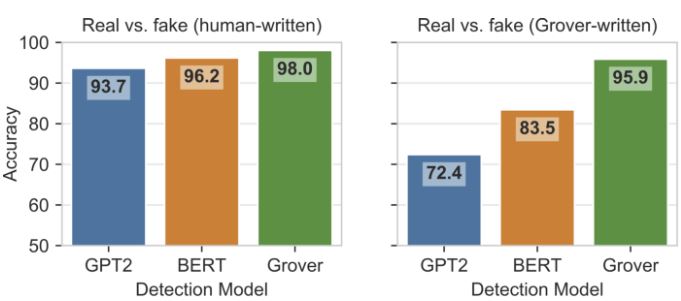 Fig: Grover model shows more than 95% accuracy in both cases (Source)
What Next?
According to the researchers, Grover is a strong step towards the development of effective automated defence mechanisms against fake news articles. A Grover model that has been adapted for detection can achieve more than 90% classification accuracy at telling apart human-written “real” from machine-written “fake” news. However, there is one possible concern which is the “rejection-sampling attack” that can fool Grover as a detector. The researchers stated that this will happen only when an adversary has access to the exact same discriminator that a verifier is using.Spotted an error? Tell our editors. Read our editorial standards and corrections.