
One of the more common approaches used to control robots is to programme them with code on detecting objects and feedback loops to specify if they should perform certain tasks. These programmes come at a cost, where reprogramming policies for each task can become time consuming.
When provided with natural language instructions, language models at present are highly proficient at not only writing generic code but also generating instructions that let the user control the actions of the robots as well.
What if robots could autonomously write their own code to interact with the whole world? One such latest language model, like PaLM, is capable of complex reasoning and has been trained on millions of codes.
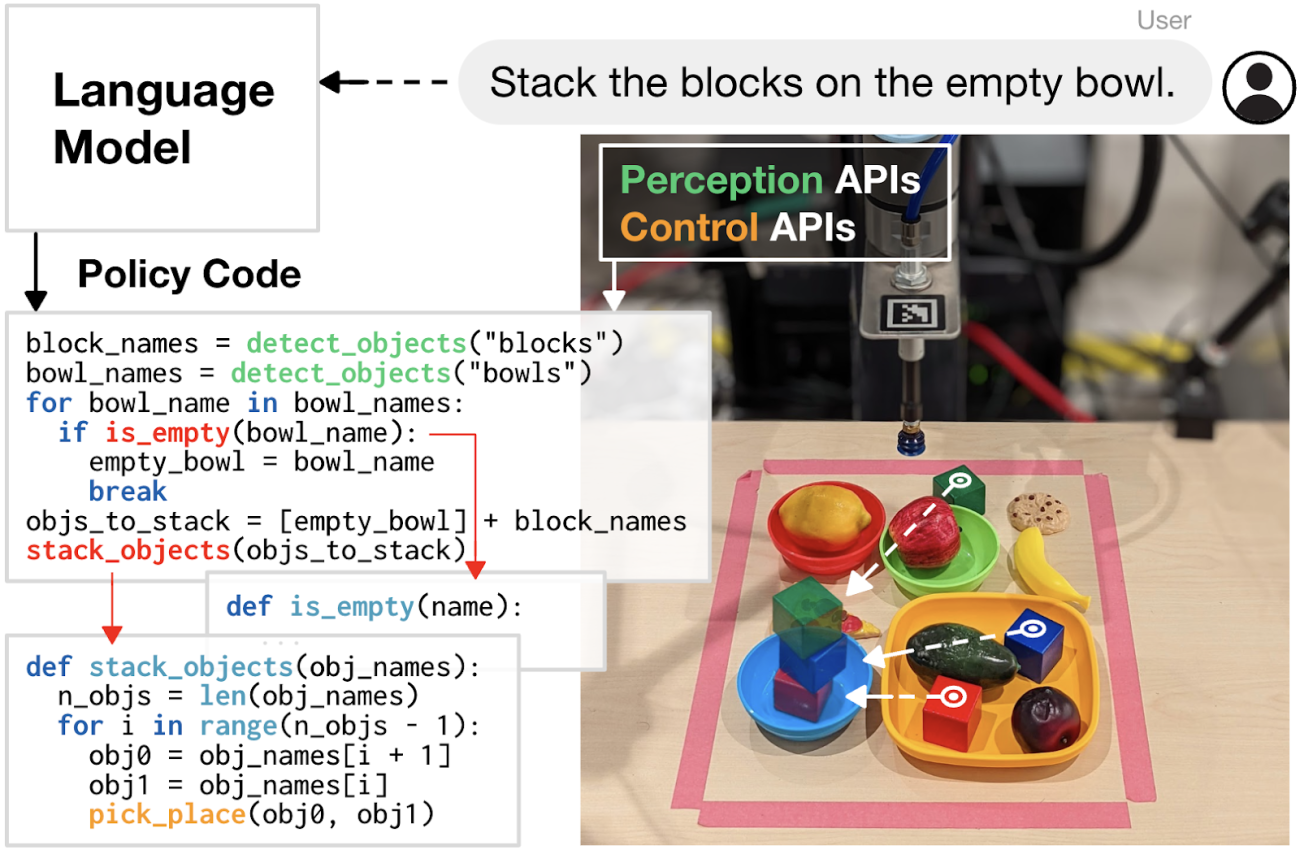
As an advancement to this innovation, Google AI has developed Code as Policies (CaP)—a robot-centric framework consisting of programmes generated by language models executed on physical systems. The new model extends their prior research—PaLM-SayCan—which will enable language models to finish complex robotic tasks using the general-purpose code of Python.
With CaP, the researchers have proposed using the language models to write the robot code directly through the method of few-shot prompting. The blog read, “Our experiments demonstrate that outputting code led to improved generalization and task performance over directly learning robot tasks and outputting natural language actions. CaP allows a single system to perform a variety of complex and varied robotic tasks without task-specific training.”
Source: Google AI
The team has released the code along with a demo of the interactive simulated robot on their project website.
Further, Google funds have also open sourced silicon manufacturing shuttles for GlobalFoundries PDK. The company released the Process Design Kit (PDK) for the GlobalFoundries 180nm MCU technology platform earlier in August 2022. This open source PDK would offer open source silicon designers with new capabilities for affordability and high volume production.
Read the whole blog here.
- OpenAI Plans to Purchase Google TPUs: Report
- Google DeepMind Unveils Genie 4 for Real-Time World Simulation
- Oracle Partners With OpenAI to Bring ChatGPT and Codex to Enterprise Workflows
- Oracle Expands AI Compute Options With NVIDIA, Google TPUs and Cerebras
- Chai Point Cuts Monthly AWS Bill by 58%
- Bengaluru AI Startup Simplismart Raises $14 Mn in NVIDIA-Backed Round