
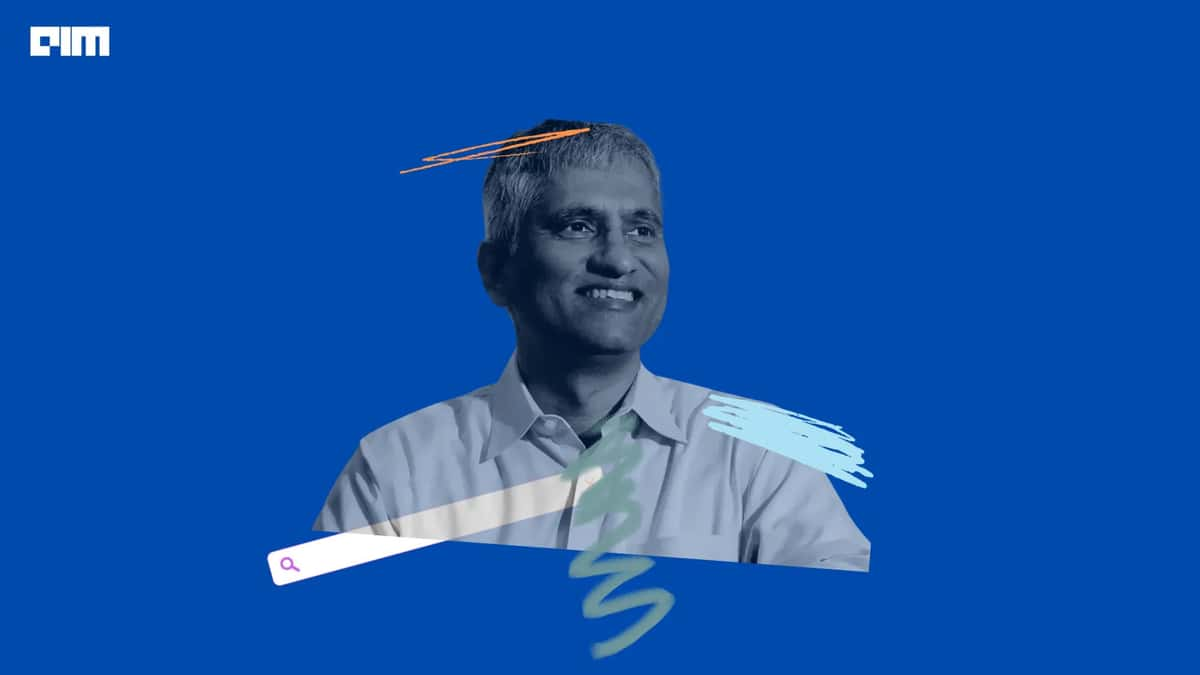
New York-based business intel search engine AlphaSense is no flash in the pan. Founded in 2011, by Wharton alumni Raj Neervannan and Jack Kokko, the company expanded on Google’s function to provide search tools specifically for query market analysis and business intelligence. In June this year, the company raised USD 225 million in its Series D round to reach unicorn status with a total valuation of USD 1.7 billion. Led by Goldman Sachs Asset Management (which doubles up as an AlphaSense client) and Viking Global Investors, the company also counts BlackRock as a noted investor.
In a chat with Analytics India Magazine, CTO and co-founder Raj Neervannan spoke about his journey in AI/ML and what it took to get AlphaSense where it is today.
AIM: You have been with AlphaSense for over 14 years now. What were some of the biggest hurdles you faced while trying to bootstrap the company?
Raj: The first thing you look at is if the problem you're solving, is in fact solvable. Secondly, not every problem is worth solving. Then you start looking at how big the problem is and how long it might take to solve it. Finally, you have to know if there will be adequate demand for the solution. If you don’t take all these things into account, the market will teach you about them anyway. Then, you have to think objectively if you are the right person to solve the problem.
At that time, analysts were still searching for insights using typical tools like Google which gave decent answers. People were used to them, but we knew it wasn’t good enough. So when Jack and I met, we realised the problem was serious enough as we had faced it ourselves. He was an analyst with Morgan Stanley and I had a background in tech-math. We wanted to go about solving something substantial that was useful to us as well. While doing our MBA at Wharton, we found that it was painful trying to get facts to build a story. We had to use different sources, financial reports and data points.
The biggest question we kept asking ourselves was, “Is it better than the next best thing, which is Google?” Eventually users started loving the product because it was a very surgical search engine and not a big hammer like Google which does a lot more. Let’s say you need a scalpel, you cannot use a kitchen knife, instead.
AIM: Many leaders say it's not as easy to find the perfect fit for the role you're looking for. Is this something you have struggled with?
Raj: Absolutely. When you're trying to solve something new you don't know if the person will be the right one. Though, I have always hired on the basis of talent and not necessarily skill. Temperament is paramount -- if candidates have the attitude of a continuous learner, are genuinely curious and passionate about solving the problem, sooner or later you’ll have the answer.
And these people aren’t necessarily from the top schools – of course your chances of finding good candidates in good schools run higher.
AIM: Do you think your technical background and Jack having worked in business was the perfect recipe for the company’s leadership?
Raj: Actually, Jack is very technical and I am very business-oriented as well. I have served as the CEO and CTO at other companies earlier and been a part of board meetings and even been on the sales side for a lot. It’s because of Wharton that I think like a business person. So even I am not a pure techie in that sense. I am able to look at a job and figure out that I am not the best person for it, and that really helps because I don’t block myself.
Jack has a solid engineering background after which he moved to work with Morgan Stanley. Both of us work together. And having worked with startups before, we understand how long it takes for a business to find its feet.

AIM: What are some of the biggest lessons across your years in the data science field?
Raj: When I graduated from BITS Pilani, I didn’t know a lot about computing. I just remember I was trying to solve an algorithm and I kept working on it for weeks and was able to solve all kinds of problems around it. So, critically, this is what I learnt -- if you keep trying and just go after something, you will find a solution for it, ultimately.
Second, you have to feel the pain of the problem that you’re trying to solve otherwise you won’t really have the conviction to solve it. Third, good companies take time to build. You always hear about how XYZ company was started in a dorm room and these stories are just evangelised. And I can tell you that’s not the case! That may be the initial spark but it takes a lot of effort to turn that spark into a fire, and it's all grunt work. You need to have the stomach for it.
And lastly, you need to believe in the market. I am very positive so I believe that sooner or later. You need to believe that the market will respond to the problems you're trying to solve.
AIM: What are your plans for expansion especially with regard to India?
Raj: There's a lot of concentrated talent in India, to say you can just set up shop at a single place like Mumbai or Delhi or Bangalore and find talent in that place, which is great. We also have an amazing team in Helsinki because Jack is from there. So, we have teams that complement each other and can learn from each other. You don’t just learn a tech stack, you learn how to work with people.
AIM: What are some of some of the biggest trends in AI/ML right now?
Raj: If you go back a bit, in 2012 Geoffrey Hinton broke through with neural networks. Since then, in 10 years we have gone from recognising a set of digits to recognising a small kid on the street and that the car needs to slow down. That's pretty amazing! So AI can be good at single tasks and they can then be generalised. That’s a huge trend now. Secondly, there is a shift in computing power -- there's better, cheaper and energy-efficient computing. So algorithms are evolving and the massive amount of hardware required is also matching up to it. So for all the sceptics who say that progress has hit a wall etc, it's simply not true.
- AI Can Be Cyborg or Centaur. But Can Enterprises Monetise It?
- AMD’s Server CPU Business Faces a New AI Boom
- How an Engineer Is Using AI to Bridge the Accessible Education Gap
- AI Agents are Making Human Customer Service a Specialist Job
- Why Nandan Nilekani-Backed F2A Believes India's Investment Opportunity Lies in Edge AI
- India Needs to Build the AI 'Brain' for Robotics, Not Just Import Hardware