
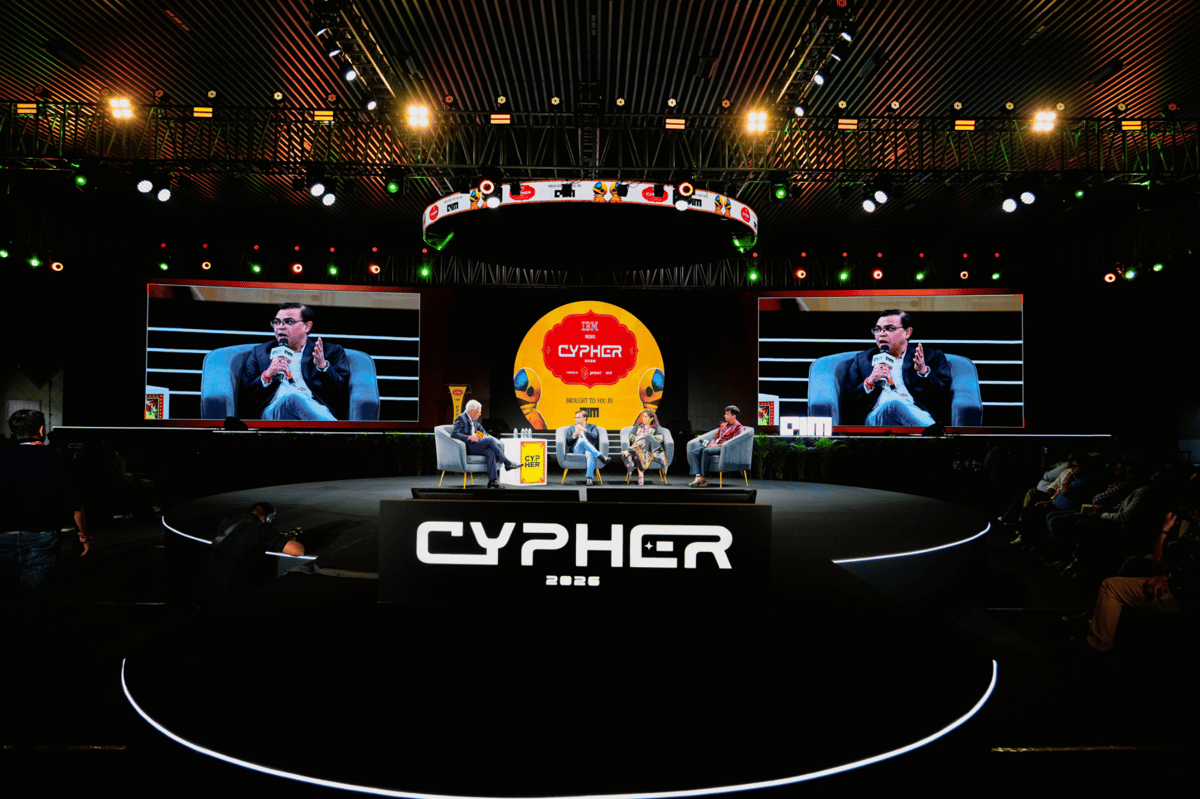

Day 1 of Cypher 2026, India’s biggest AI summit and expo, explored what happens after AI gives an answer. Day 2 widened the lens to who owns the work, what powers the system, and which governments can switch it off.
GCCs: Delivery Engines or Decision Centres?
A question on whether India's 2,100+ global capability centres (GCCs) are becoming global delivery or decision centres drew a blunt answer. Rupesh Kumar, Chief Product and Technology Officer at WeWork India, said, "I would say both."
Kumar sorted GCCs into four stages—from execution-only cost centres to process ownership, end-to-end delivery hubs, and finally, transformation hubs led by a CXO with real autonomy. AI, he said, exposes the first two stages because much of their work can be automated, while it amplifies the third and fourth.
According to a study by the Inductus Group, about 55% of GCCs are in stages one and two and 45% in stages three and four, with only around 5% in stage four. The time to move from stage one to three, he said, has shrunk from 5–10 years to 3–4.
Anshu Sharma Raja, Group CIO at Arab Bank, argued that India no longer has a natural IT advantage. "AI is not an outsourcing game at all," she said, adding, "you need less people, but sharper outcomes."
According to the EY GCC Pulse Survey, only about 20% of GCCs have autonomous decision-making ability. Real ownership, she said, means owning the budget, the roadmap, and the 3 am call when something breaks. Trust, she added, is not handed over; "It has to be earned."
Ramit Bhardwaj, CTO of IndiQube, was more optimistic about AI's effect on India, calling it an efficiency multiplier that expands the problems worth attacking. AI shortens the climb from stage one to three, he said, but the jump to stage four is about organisational strategy rather than technology.
On real estate, the workspace providers said AI hasn't hurt demand. Seats per client may be moderating, but the number of GCCs is growing, and customers now want flexible layouts and guaranteed uninterrupted power. Kumar said GCCs account for about 40% of WeWork India's revenue this year.
Building on the momentum, Genpact powered Day 2. The day featured impactful contributions from Platinum Partners Dell Technologies and NatWest, alongside Gold Partner Mastech. Rounding out the strong showcase were Silver Partners Cockroach Labs and C5i, whose active involvement added distinct depth and expertise to the day’s sessions.
Emotions, AI, and Films
Actor and Prismix Studios CEO Vatsal Sheth said AI filmmaking still depends on human creators like writers, directors, cinematographers, actors, and musicians. His AI short Happy Birthday Joshi, based on the early-1990s Indian boot-sector virus, was built around emotion rather than spectacle.
"Behind AI there has to be a human intervention," he said. "The film needs to have the right emotion. The story has to be amazing." He expects a hybrid future, and Prismix is partnering with Indian universities on an AI-filmmaking curriculum.
The Next Limits on AI are Physical
Michael Ferrari, Chief AI Officer at Moby, argued that AI's expansion will be capped by power, water, materials, and silicon. Using International Energy Agency projections as a proxy, he said data centre electricity use is set to double over five years from a 2025 baseline, with the AI share tripling.
He pointed to US grid operator PJM, where spare capacity has fallen from about 70 GW in 2022 to 18 GW, with a deficit of roughly 40 GW possible within five years. "If they defy the laws of physics, it's not going to matter," he said of the investment products meant to fund the energy transition.
His proposed bridges are the ocean, where undersea data centres offer efficient cooling, citing a power usage effectiveness of 1.07, and then the space orbit. He called the ocean "a bridge towards ultimately moving compute off planet."
Space compute still costs about four times as much per GPU-hour as terrestrial compute, and heat dissipation and launch costs remain hurdles. He expects a viable commercial market in the 2030s, but added, "It's probably going to be closer to 2040 than 2030."
Q-Day and a Nearer-Term AI Opening
IISc Professor Arindam Ghosh said roughly 1,000 logical qubits, expected between 2030 and 2035, would make a fault-tolerant machine able to break RSA encryption, the so-called Q-Day.
Quantum-AI advantage may arrive sooner: about 60 logical qubits could deliver exponential gains on large data problems like DNA sequencing, possibly by 2028. He put that at around 10,000 physical qubits, though his stated assumption of 100 physical qubits per logical qubit would imply closer to 6,000.
"Quantum and AI are not mutually exclusive; they are mutually complementary," he said.
On security, he said quantum products are effectively sanctioned and dual-use, so "each country will have to build their own computer." Commercial access will come through hybrid quantum data centres over the cloud rather than laptops.
India, the Spec Capital of the World
Sneha Roy, Co-founder and COO of Murf AI, reframed India's "edge cases" as specifications.
"The edge case is the specification," she said, citing Google Maps' offline mode, Netflix's mobile-only plan, and Uber's cash rides as India-born features that went global.
Voice AI must handle code-mixed speech, non-standard addresses, and numbers pronounced in several ways within one sentence. Constraints on GPU availability pushed Murf to shrink its models, she said.
Roy said the company has deployed its models in 11 countries and tested them across 32 data centres, with median latency of 60–90 milliseconds. She claimed its Falcon 2 model ranked above several frontier models in third-party benchmarks.
Her test for the technology: "If any such customer has to still explain to the agent or repeat what they said again and again, I think we are not finished building yet."
Geopolitics Meets the AI Roadmap
Market access and public policy leader Anuraag Saxena told export-focused founders that the question is no longer just "can I build it" but how to remain allowed to build, finance, compute, sell, protect, and hire in target markets.
His three takeaways were to think geopolitically from day one by mapping where compute, data, IP, capital and talent sit; to hedge across jurisdictions, since redundancy is now "geopolitical insurance"; and to treat government affairs as a startup function.
His definition of sovereignty was "where no one else can unilaterally switch you off," rather than building everything yourself. He described the US relationship as one "where they need us, but they don't want us."
Markets, Agents, and a Cracked PDF
Ambarish Kenghe, Group CEO of Angel One, said India is still early in equity investing.
By his figures, 50–55% of household wealth sits in real estate, and equities account for under 10%. He described starting his day with an AI agent briefing on markets, and using Claude's Fable model to review about 52 stocks on which his research team didn't think margin could be offered.
The run cost about $70, he said, and it flagged four stocks to send back, 15 needing more research, and advised not bothering with the rest.
His cautionary tale involved an AI agent he had asked to calculate peak balances across four bank statements. One was a password-protected PDF, and the agent opened it on its own, inferring the password pattern and using a customer ID from another file. He wished it had told him what it was doing.
"It's very powerful, yet we have to be very careful," he said. Data management has become easier with AI, he said, but "what has become harder is protecting it." On regulators, he said SEBI and RBI consult widely and are open to input that serves consumers and the ecosystem.
If Day 1 was about decisions, agents and sovereignty, Day 2 added the constraints. Autonomy has to be earned, power and geopolitics can cap growth, and India's strongest argument may be that its hardest problems make the best products.
- Industry Wants Faster Approvals and Cheaper Power in India’s Data Centre Policy
- Inside Jio Platforms: Its Tech Bets, Loss-Making Subsidiaries and Hidden Risks
- India’s GCCs to Add 1.4 Million Jobs, Drive 170 Million Sq. Ft. Office Demand by 2031
- AI Can Be Cyborg or Centaur. But Can Enterprises Monetise It?
- AMD’s Server CPU Business Faces a New AI Boom
- How an Engineer Is Using AI to Bridge the Accessible Education Gap