


For years, scientists have been excited about carbon nanotubes (CNT)—nanometre-scale tube-like structures made of carbon that can conduct electricity better than copper and are far stronger than steel. They have shown promise in everything, from faster processing in chips to longer-lasting batteries and even making rockets more efficient.
Yet carbon nanotubes have stayed inside labs. The challenge lies in making them reliable, as each batch behaves differently, limiting real-world use. Since its inception in 2011, a Bengaluru-based company has been chasing this material.
NoPo Nanotechnologies produces single-walled carbon nanotubes (SWCNTs) at an industrial scale. The company claims it has solved one of the hardest problems in the field: ensuring production consistency.
But the story of NoPo does not begin in a lab. It begins with space exploration.
Founder Gadhadar Reddy recalls that since childhood, he’d always dreamt of going to Mars. That curiosity soon turned into exploring a more practical question of why going to space was still so difficult.
“The reason we can’t experience it is that we don’t have such materials. Going to space requires core materials,” the CEO tells AIM.
That realisation shaped the company. If materials were the bottleneck, solving them could unlock everything else. Today, NoPo works with customers across batteries, electronics, and materials science sectors. It supplies nanotubes for evaluation and early-stage deployments.
Yet, more than a decade in, much of its commercial journey is still unfolding, with limited revenue and large-scale adoption still some distance away.
What Have They Been Doing?
For Reddy, the problem with nanotubes is their unpredictability. If the product keeps changing size every single time during manufacturing, it’s not useful.
CNTs naturally clump together rather than dispersing evenly, which makes it difficult to achieve a uniform dispersion in a matrix when rolling them. Moreover, CNT-polymer composites do not give any structural control over how the nanoparticles are arranged.
“You need to be able to produce the exact same ingredient and the exact same particular dimensions, again and again,” he says.
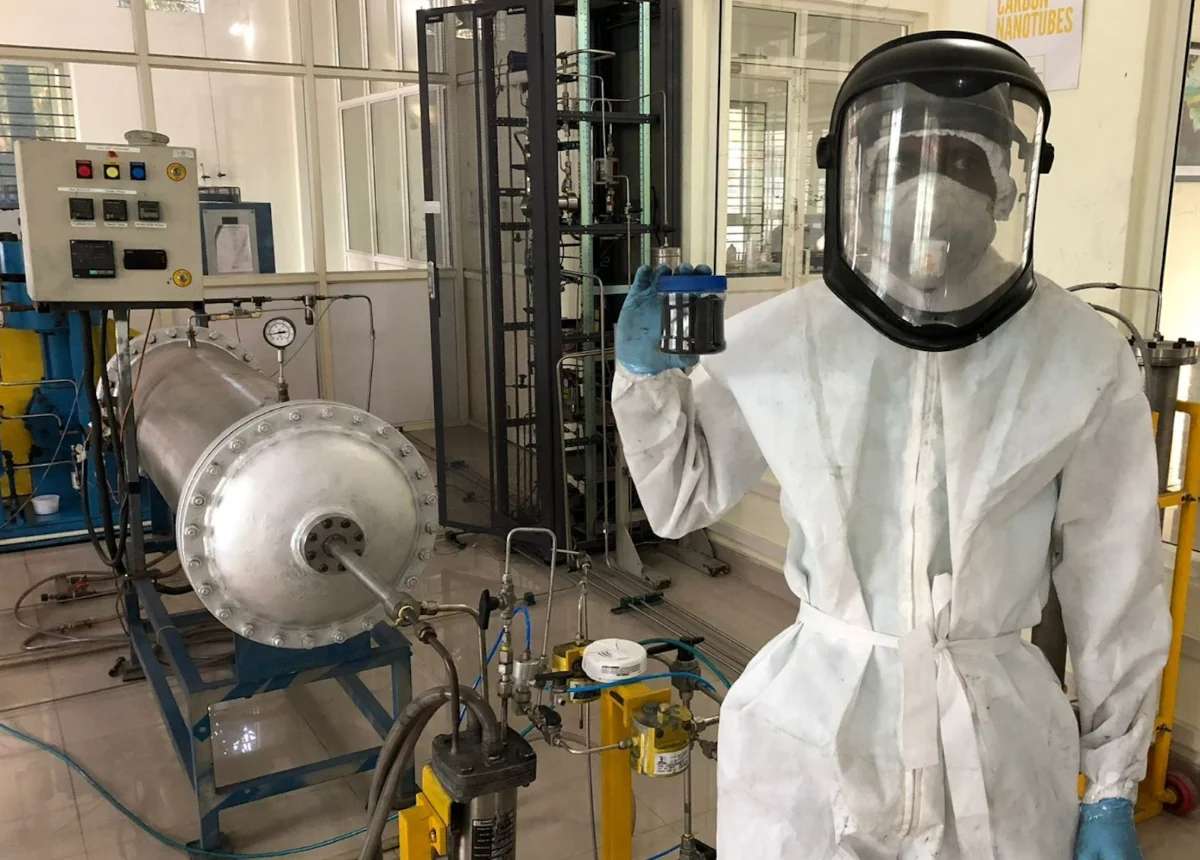
NoPo focuses on solving this through its version of the HiPCO (High-Pressure Carbon Monoxide) process. This process uses carbon monoxide to split one carbon atom, producing carbon dioxide (CO2) as a byproduct. Further, CO2 is stored, and the carbon atom attaches itself to iron to form the nanotubes.
The company has been working on controlling the diameter and purity of nanotubes, two factors that directly affect performance. Reddy says that the team realised very early on that external vendors could not meet their requirements. Instead of outsourcing, it began building systems in-house.
That mindset became part of the company’s culture, but the early days were slow and uncertain. Initially, their reactor would run for 2–3 days and yield only 1 milligram of the material. Today, the production has scaled to several grams per hour.
Co-founder Anto Godwin says the process remains complex. One might assume that a four-parameter reaction involves controlling just four parameters, such as temperature and pressure. But in reality, NoPo has to control 200 more parameters just to maintain those four constants.
Tubes So Small, They’re Powder
Most companies working in this space produce nanotubes with diameters of around 1.4 nanometres or larger. NoPo has pushed that down to nearly half. “What we do is around 0.8 nanometres,” Reddy says.
That difference, while microscopic, changes everything.
At larger sizes, nanotubes behave like good conductors. But as they get smaller, their properties begin to shift. Some become semiconducting, which means they can be used in electronics. Others become more efficient conductors, requiring smaller quantities to achieve the same effect.
In practical terms, this means companies can use less material and still get better performance. In batteries, that translates to improved conductivity with lower loading. In electronics, it opens the possibility of replacing or complementing traditional materials, such as silicon, in chip fabrication.
The company has also worked to narrow variation within each batch. Instead of producing a mix of sizes, it focuses on specific diameters with tighter control. This consistency is what makes the material usable.
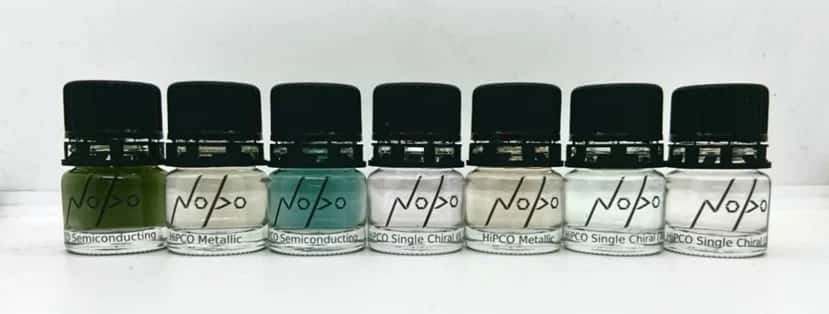
It also explains why NoPo positions itself differently from other players, such as CHASM Advanced Materials and NanoIntegris. The company wants to sell the trust of predictability, something the industry has struggled with for years.
“Nanointegris is our distributor. All HiPCO listings [on its platform] are from NoPo,” he says, adding that earlier, Nanointegris used to buy material from the research reactor at Rice University, US.
As for CHASM, he adds that it produces COMOCAT nanotubes (used in electronic devices, field-effect transistors) for research purposes. “Their scale stagnated at a kilogram and couldn’t be increased beyond. Their COMOCAT nanotubes are also significantly more expensive as they use cobalt and molybdenum in alumina, and it is a batch process.”
However, adoption still takes time. Customers need to test, validate, and integrate the material into existing systems. And in industries like semiconductors, that process can take years.
Across Layers
NoPo’s material has applications across sectors. The company has explored semiconductors, water filtration, polymers, and space systems. But not all of these are equally close to market.
Batteries currently offer the clearest path. Nanotubes improve conductivity and stability in battery systems. The company is working with partners on sodium-ion batteries and other energy storage systems.
Semiconductors, while promising, remain further away. The material can potentially replace or complement silicon in some use cases. But commercial deployment will take time. “We believe that in another two years, the device will come,” Reddy says.
Most customer relationships are still in testing stages as companies focus on evaluating the material before committing to large orders. Reddy acknowledges that the business is at an early stage. The gap between technical capability and market readiness remains a key tension. The company has built a product, but large-scale demand has yet to fully materialise.
NoPo operates in a global market with a few established players like OCSiAl, Japan-based Resonac Corporation, and South Korea’s LG Chem. As per Grand View Research, the global carbon nanotubes market is projected to grow at a CAGR of 14.1% to reach $8.15 billion in 2030.
The startup positions itself as a local alternative. It sources most of its inputs domestically and manufactures in India. But selling from India presents its own challenges. He notes that Indian companies often need to prove themselves repeatedly before gaining traction, whereas a foreign company can come to sell its tech in India. “We don’t trust each other at all,” he observes.
The company has found more traction abroad and has worked with customers in Japan and Taiwan, supplying materials for evaluation. Published research and technical validation have helped build credibility.
NoPo now needs to move from small-scale supply to large-scale manufacturing. That requires capital, infrastructure, and steady demand.
The company has raised limited funding so far, totalling $3.36 million across six rounds. It continues to invest in engineering and production capacity. It is also expanding reactor systems to increase output.
Reddy sees materials as central to future technologies. “Any kind of technology is because of the materials,” he says. But he also recognises the gap between potential and adoption.
- From Humanoid Robots to Telecom Trials, 12 Major Announcements at NVIDIA GTC Berlin 2026
- Anyone Can Make a Robot Move, Few Can Make It Stop
- After ISRO’s PSLV Failure, TakeMe2Space Looks to SpaceX for Reliable Launch
- Why AI Agents are the Next Frontier in Quantum Security
- Physical AI Squeezes Labour Market, And Low-Skilled Immigrant Jobs May Be First to Fall
- Rocket Math Isn’t Mathing: Why India’s Space Launches are Expensive