Key takeaways
- TikTok's user engagement is exceptionally high, with users spending an average of 52 minutes daily on the platform.
- The platform achieved one billion users faster than its competitors, highlighting its rapid growth.
- TikTok's addictive nature is linked to its immersive content, making it a leader in social media engagement.
- The majority of TikTok users access the app daily, with a significant portion spending over 10 hours weekly.
- The shift from social graphs to content-focused platforms reflects a change in how social media operates.
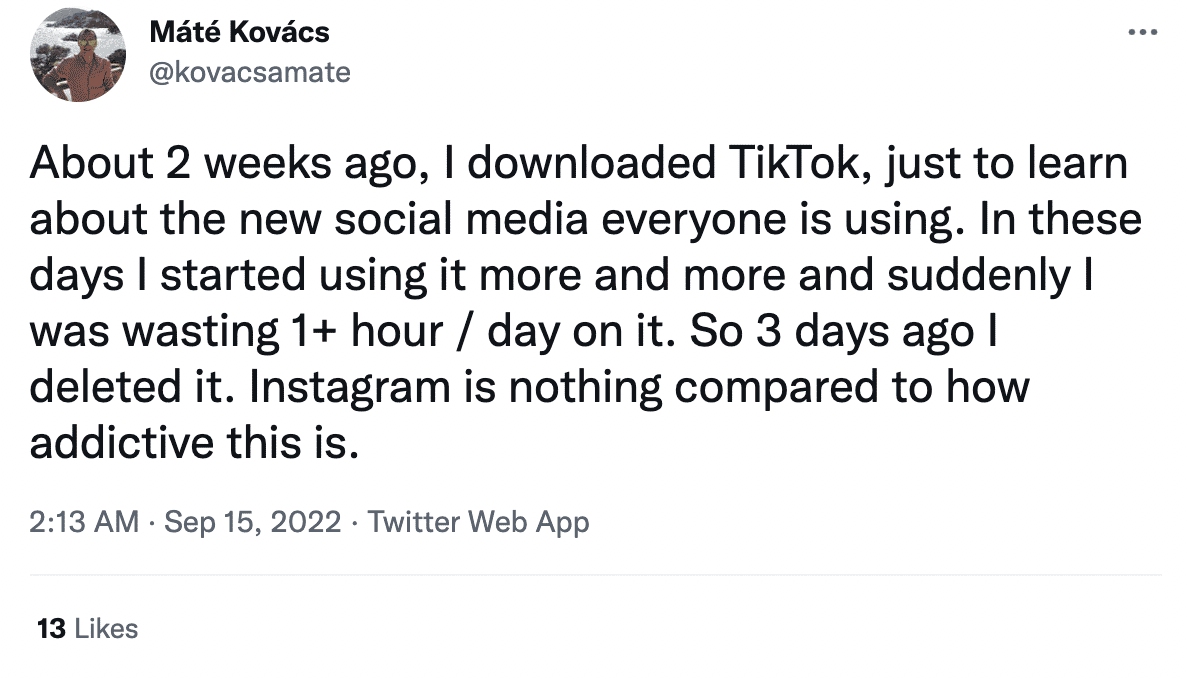
Social media platforms constantly keep evolving—each platform does their mightiest best to get users more addicted. In the context of technology, ‘addiction’ hardly carries a negative connotation. The more addictive a digital experience is, the more immersive it is considered. Among the current crop of social media companies, ByteDance’s TikTok takes the cake. If social media is in the business of addiction—TikTok is crack cocaine. The platform touched the one billion benchmark for its users faster than any of its rivals.
Currently, TikTok has nearly 689 million users globally with 600 million monthly active users. But the success of an app predominantly depends also on how engaged its users are. And TikTok, has colossal user engagement—an average user spends 52 minutes on the platform each day, a total of more than 6 hours per week. Of these, 90% of TikTok users are on it daily while 60% of the users are on it more than 10 hours per week.
From social graphs to pure content platforms
Facebook, which essentially came up with the idea of social media, wanted to connect users with their friends around the world. This is the system of the social graph. In brief, a social graph is a global mapping of “everybody and how they’re related to each other.” TikTok has discarded the more personalised social graph mechanism for a sophisticated algorithm that simply zones in on the content the user likes and continues to show it. Like YouTube, TikTok didn’t want or need the user to follow people intentionally, the user followed content instead. Wall Street Journal referred to using TikTok as akin to falling into ‘a rabbit hole of very niche content.’
TikTok’s secret sauce is its AI-powered recommendation system. The system could be using a mix of two methods or either of them to keep the user hooked in. The first possibility is that the AI engine trains itself to tap into the user’s interactions, what they like and share to follow an authority ranking system. The recommendation engine then keeps pushing the content creators similar to the ones that the user likes.
The other possible mechanism is when the videos are arranged into groups depending on scores given by the system itself. These videos are then pushed into the audience based on the basket it ends up in. Whichever method is involved, the wheels are set in motion based on user behaviour.
Can AI make TikTok more addictive?
But TikTok’s user engagement may not be the peak for social media platforms yet. Given the direction in which current trends in AI are heading, there is a good chance that social media becomes even more addictive and equal parts interesting and disorienting.
Nicholas Thompson, CEO of The Atlantic discussed the possibilities of the future of social media recently in a LinkedIn post. According to Thompson, it won’t be long until a big portion of the short videos we watch online are algorithmically generated. ‘How long until the most viral short videos are AI-generated humans doing things the machine knows we’ll want to see?’ he asked.
Let us consider the ingredients.
There is a deluge in AI-based text-to-image generators since the revolution started by OpenAI’s DALL.E 2. It didn’t take long until these tools that produced high-quality images were released to the public—MidJourney came out sometime later. Next came Stable Diffusion, which was the first tool to open source its code. The tool also had filters on text prompts which could be easily disabled. Users ended up producing pornographic images and images representing real-life personalities. The worst case scenario of this unholy mix could escalate the danger of deepfakes.
Since then, new text-to-video tools have come up like the open source CogVideo. While the tool is still in the early stages, the possibilities are endless. Tools like MidJourney can be linked to GPT-3 to produce images. The output can then be fed into GANs or Generative Adversarial Networks to make images with the likeness of people. If successful, the same can be done by connecting text-to-video generators to GANs to generate similar output.
However, with the emergence of tools like Stable Diffusion, it has become the simplest thing to integrate its API with an application.
Thanks to TikTok’s laser-sharp recommendation system and these advances in AI, the prospects for social media could look like this—users will watch AI-generated content that will be tailored to their taste. As Thompson stated, the day isn’t far off when users won’t be able to distinguish whether the content is AI-generated or not.
Spotted an error? Tell our editors. Read our editorial standards and corrections.
Selling to AI teams? Put your brand in front of the 5M+ people who read AIM every month. Plan a campaign