
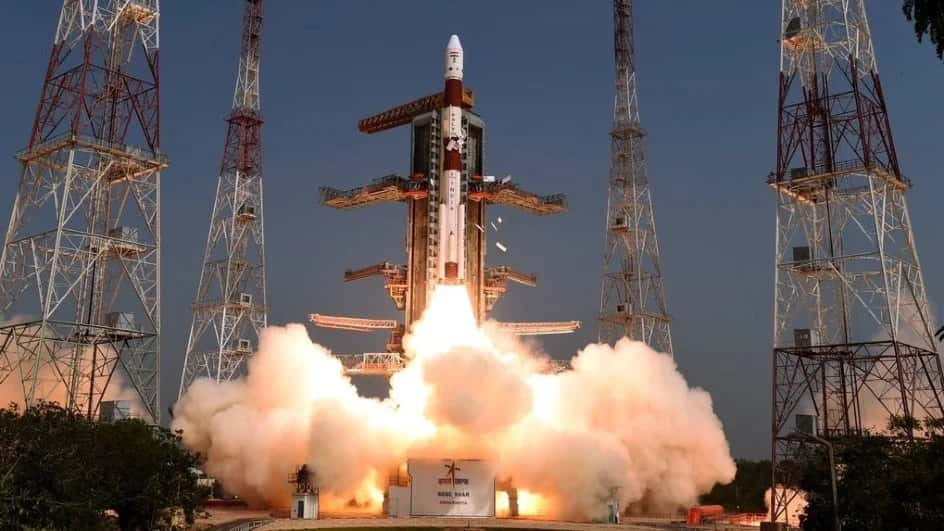

Nearly 100–120 scientists reportedly resigning from the Indian Space Research Organisation (ISRO) within a few months has sparked concern over whether talent is shifting from India's premier space agency to the fast-growing private space sector.
According to a TOI report, nearly 80 scientists have exited the U R Rao Satellite Centre in Bengaluru, while around 20 have left the Vikram Sarabhai Space Centre in Thiruvananthapuram.
In response, the Department of Space (DoS) issued a memorandum on July 14, directing all ISRO centres not to process resignation or voluntary retirement requests from scientists working on Gaganyaan and other "important missions." Instead, such requests must now be referred to the DoS for final approval.
The move reverses a 2020 policy that allowed ISRO centre directors to accept resignations from Group A scientific and technical personnel. By centralising the decision-making process, the government has signalled that talent retention is now a strategic priority for India's space programme.
The concern is not entirely unfounded. ISRO reportedly has 2,613 vacancies against 18,142 sanctioned posts across science, technology, and administration, leaving the organisation with a workforce shortfall of 14.4%.
The departures have inevitably fuelled speculation that private space startups are pulling talent away from the government agency.
Companies such as Skyroot Aerospace, founded by former ISRO scientists Pawan Kumar Chandana and Naga Bharath Daka, along with firms like Pixxel and Agnikul Cosmos, have emerged as attractive destinations for scientists, offering faster career growth, greater flexibility, and opportunities to work on cutting-edge projects.
Then there are high-profile talent movements such as former ISRO Chairman S Somanath joining the board of AgniKul Cosmos. Meanwhile, Devakumar Thammisetty quit ISRO to found Astrobase in 2024, developing advanced reusable rocket engines.
However, not everyone sees the trend as alarming.
Talking to AIM on the condition of anonymity, a scientist and alumnus of the Indian Institute of Space Science and Technology (IIST) currently working at ISRO, downplays the exodus, saying that employee movement across organisations is a natural outcome of a maturing space ecosystem rather than evidence of a crisis within ISRO.
"This is quite normal and routine. It may be that a lot more people are joining private space industries, but I don't think people were not joining other industries when the [private] space industry was not there. It is pretty normal," the person clarifies.
Yet, India’s private space sector is evolving into a great attractor. According to the Ministry of Science and Technology and Space, India’s space economy has grown to an estimated $8.4 billion, with 399 startups now operating across launch vehicles, satellites, propulsion systems, and space-grade electronics.
While this has intensified competition for talent, experts argue that the movement of skilled professionals across organisations is also a sign of a healthier and more diverse space ecosystem.
Compensation is Not the Entire Story
One explanation often cited for scientists leaving ISRO is the difference in compensation offered by private companies. However, the researcher argues that salary alone does not explain career decisions.
“Whatever people get into, they know the structure. It is quite a public thing, so you know what to expect,” the ISRO scientist states, adding that government pay structures are standardised across organisations and cannot be changed independently by ISRO.
The researcher also points to past government initiatives aimed at attracting and nurturing talent, such as establishing IIST.
“There was a scholarship—100% for people studying there—and they have contributed significantly to space missions. When you offer something to people like good education and good security, then people perform,” the scientist notes.
With India's space startups scaling rapidly, the demand for specialised talent is also rising exponentially. As per data from HR solutions company Adecco India, the country's aerospace, drones and space technology industry is projected to grow 5x to $44 billion by 2033, creating over 200,000 new jobs.
Some observers suggest that ISRO resources are an easy catch for private firms. However, the researcher believes this interpretation oversimplifies the situation.
The person argues that talent mobility should be seen as a sign of ecosystem growth rather than institutional weakness.
India's space reforms over the past few years have encouraged private participation, leading to the emergence of launch vehicle companies, satellite startups and downstream space technology firms. As a result, engineers now have multiple career pathways within the sector.
“It is simply an oversimplification that private space companies are drawing out experts,” the ISRO scientist mentions.
Will Ongoing Missions Be Affected?
ISRO has been actively focusing on the Gaganyaan programme for human space flight, testing deceleration and parachute systems, as well as configuring for structural integrity and design margins. It plans to launch the Chandrayaan-4 mission in 2027 to obtain lunar sample, as well as Venus Orbiter Mission in 2028 to study the planet.
A key concern raised by observers is whether the departure of experienced scientists could impact ongoing missions or delay future projects.
The ISRO researcher dismisses that notion, explaining that space missions are designed to be institution-driven rather than person-dependent. “A space mission generally involves many people across centres. It is made to ensure that it does not depend on one person,” the person notes.
Why India's Space Startups Matter
Aniruddha Mukhopadhyay, S&A Lead Chief Technologist, Synopsys, believes the growth of tstartups such as Skyroot Aerospace, Pixxel, and Agnikul Cosmos as a natural evolution rather than a threat to government institutions
“The root success criteria of a startup is economic disruption,” he states.
Startups can take risks that large organisations often cannot because of procedural and policy constraints. “They are able to make innovative, dangerous, sometimes very risky initiatives that an established organisation cannot do,” he adds.
At the same time, he believes government support has fundamentally changed the startup landscape. Pointing to initiatives such as the Ministry of Defence's Innovations for Defence Excellence (iDEX) programme and various semiconductor and deeptech funding schemes, he says the government is now actively creating pathways for innovation.
“The government is clearly saying these are the problems I need a solution for,” he says.
Samir V Kamat, ex-Chairman, DRDO and Secretary of R&D at the Department of Defence, believes the issue of public sector innovation is often framed incorrectly.
"We need to achieve a balance. Organisations like DRDO and ISRO also have a role. Startups also have a role," Kamat explains.
The focus, he says, should remain on national objectives rather than institutional boundaries.
"Whether the work is done in DRDO, ISRO, or in a startup should not matter. We need to have a [common] goal as a country," Kamat claims.
Having spent nearly four decades at DRDO, Kamat believes talent movement within India's innovation ecosystem should be viewed positively rather than as a loss. His decision to stay at DRDO was driven by passion for the work rather than financial incentives. "I enjoyed what I was doing. If you enjoy what you are doing, the other factors don't matter as well," he notes.
He also rejects the notion that government scientists lack the freedom to innovate. "I don't agree with that because from my personal experience, if you put your idea properly, you have enough freedom to pursue it," he says
- AMD’s Server CPU Business Faces a New AI Boom
- How an Engineer Is Using AI to Bridge the Accessible Education Gap
- AI Agents are Making Human Customer Service a Specialist Job
- Why Nandan Nilekani-Backed F2A Believes India's Investment Opportunity Lies in Edge AI
- India Needs to Build the AI 'Brain' for Robotics, Not Just Import Hardware
- Why Enterprise AI Prototypes Break in Production