
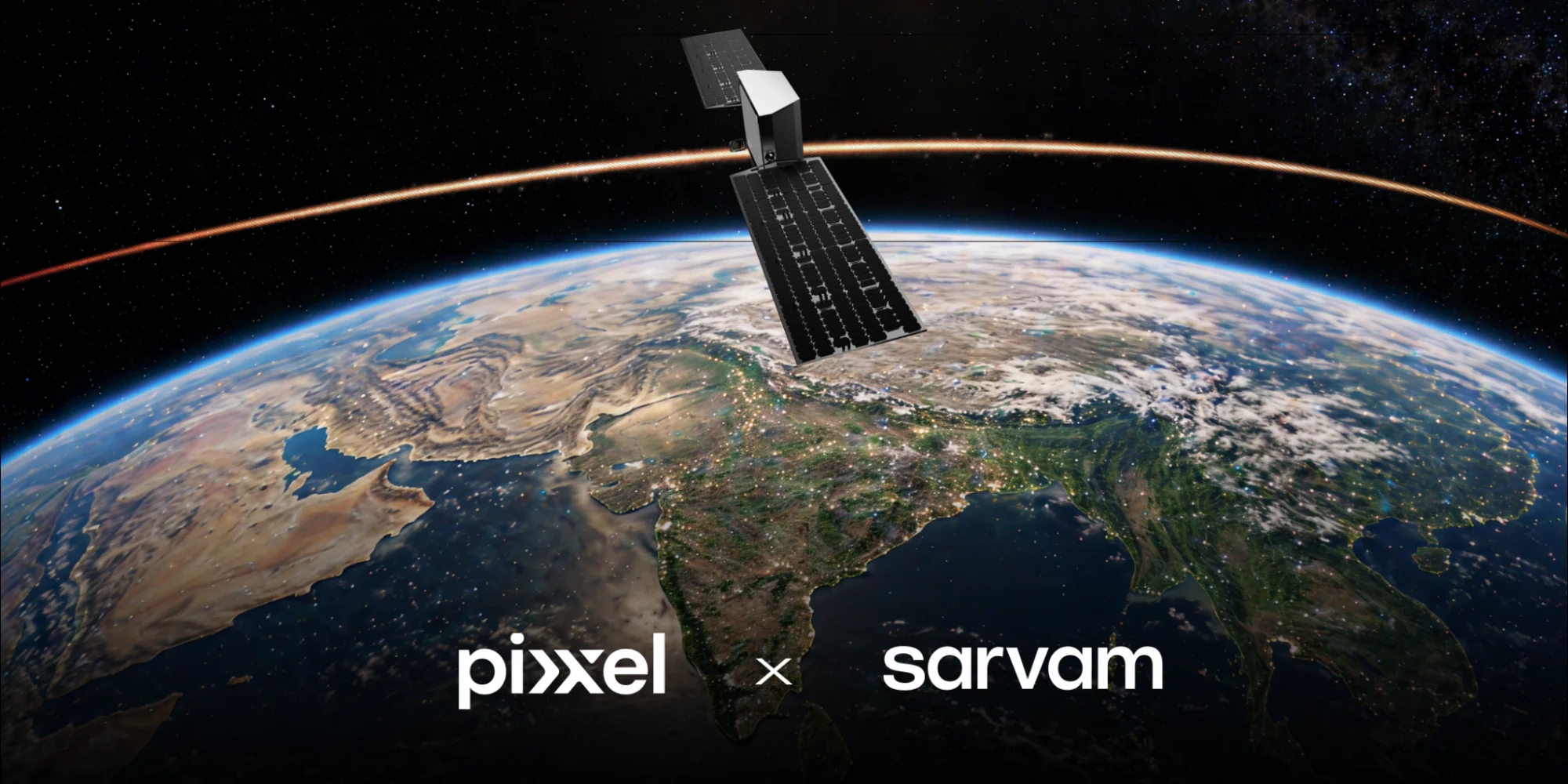
Space tech startup Pixxel has partnered with Sarvam to develop an orbital data centre satellite, with a launch targeted as early as the fourth quarter of 2026.
The satellite, named Pathfinder, will be designed, built, launched, and operated by Pixxel, while Sarvam will provide the AI infrastructure, enabling both training and inference directly in orbit.
The companies said the system will run full-stack language models on board without relying on ground-based cloud infrastructure.
The Pathfinder satellite, in the 200 kg class, will carry data centre-grade GPUs typically used in terrestrial AI systems. Unlike conventional satellites that use low-power processors, the system is intended to process data in orbit. It will also host Pixxel’s hyperspectral imaging camera to capture Earth observation data and analyse it in real time.
According to the companies, this approach reduces the need to transmit large volumes of raw data to Earth. Instead, the satellite will process imagery in orbit to identify patterns and generate insights, with applications in environmental monitoring, resource management, and infrastructure tracking.
“Ground-based data centres are facing increasing constraints around energy, land, regulation, and scale, and the current model is becoming harder to sustain environmentally,” said Awais Ahmed, CEO of Pixxel. “Orbital data centres open up a new frontier, where compute can be powered by solar energy, operate closer to space-based data, and move beyond some of the limits faced on Earth.”
Sarvam said the partnership extends its AI platform into space, with models developed in India running directly on the satellite.
“AI infrastructure is not just a software question—it is a sovereignty question,” said Pratyush Kumar, CEO of Sarvam. “Partnering with Pixxel allows us to extend that stack into space. Having India-built models running in orbit aboard an India-built satellite is the kind of capability the country needs to control its own intelligence infrastructure.”
The mission will test AI inference and data processing in orbit, including performance, power use, thermal conditions, and data workflows. The companies said the project is intended to establish the basis for future orbital data centre systems.
The satellite will be developed at Gigapixxel, a manufacturing facility being set up by Pixxel to scale satellite production to up to 100 units.
The partnership will demonstrate a model for deploying orbital data centre satellites for organisations with compute-intensive and strategic requirements.
Meanwhile, Agnikul Cosmos and NeevCloud are also working on an AI data centre in space, with a demonstration targeted around 2026. The plan involves converting the upper stages of Agnikul’s launch vehicles into orbital compute modules, with NeevCloud providing the AI and cloud stack for in-orbit inference.

Your reaction
Discussion
What's your take on this story?
No comments yet — be the first to share your view.